
Nursing home marketing is the work of keeping a skilled nursing facility’s census full — winning referrals from the hospital professionals who control skilled admissions, and winning the confidence of the families who ratify those decisions online. The field holds 14,700 nursing homes (CDC, 2022), and Net Solutions Interactive is a senior care marketing agency built for the skilled nursing operators competing in it. Per CDC data, those homes had a combined licensed capacity of 1.6 million and 1.2 million residents in 2022, and 72.4% of them were for-profit.
For a skilled nursing organization, census turns on one relationship set: the hospitals, physician groups, and discharge planners who decide where a patient goes next. What follows is how we approach that decision — which of those sources actually produce admissions, where a marketing budget earns its place, and what makes a facility the first call rather than the overflow one. Where MedPAC figures appear below, they describe traditional fee-for-service Medicare rather than Medicare Advantage.
- Nursing home marketing is referral infrastructure before it is advertising — the facility that answers a discharge planner fastest, with a clear yes or no, wins admissions the best brochure never sees.
- The buying decision is split: a hospital professional builds the shortlist and a family ratifies it online, so a facility has to be credible to both audiences, in that order.
- Your reputation is already published (the CMS star rating, review profiles, and inspection records are public), and the only real choice is whether you participate in shaping what they say.
- Digital channels fill long-term care and private-pay census while relationship channels win skilled admissions, and a strategy that funds one while starving the other leaves a wing empty.
What is nursing home marketing, really?
Strip away the vendor language and it is a system with a few moving parts: referral relationships with the people who discharge patients, an admissions process fast enough to capture what those relationships produce, a digital presence that survives a family’s scrutiny, and a reputation layer that hospitals and health plans consult when they decide which facilities stay on their lists.
Marketing a nursing home is unlike marketing any other senior care setting because the buyer is split. A discharge planner chooses under time pressure, on clinical and payer criteria, often the same day. A family chooses under emotional pressure, on trust criteria, usually starting from a search bar. Most facilities market to only one of them — and usually the wrong one for the census they need to build.
It is worth naming what nursing home marketing is not: a glossier brochure, a refreshed logo, a billboard on the road to the hospital. Those are artifacts. The system is what produces admissions.
Why does census pressure feel different now?
Because the structure of the referral world changed underneath the industry. Hospitals discharge sooner and sicker, and those in Medicare bundled-payment models now steer their discharges toward narrow networks of preferred facilities, and a building left off those lists does not lose a referral, it loses a category of referrals.
Home health has become the default destination for patients who once filled skilled census, so the patients who do arrive carry higher acuity and tighter authorizations. Staffing sets a hard ceiling on the census you can actually accept, which makes every admissible referral more valuable. And families now research a facility long before they walk in — the star rating, the reviews, the photographs, the last inspection, all read on a phone in a hospital hallway.
The census math is public. Per MedPAC’s March 2026 report, the median facility ran at 83% of capacity in 2024, but a quarter of buildings ran above 91% while another quarter sat at 70% or below. That spread is the whole argument for this page: buildings in the same market, under the same pressures, land in very different places. Meanwhile the field is consolidating slowly, down 0.8% from the prior year to 14,518 Medicare-participating facilities, and in 2024 about 14,400 freestanding facilities delivered 1.5 million Medicare-covered stays to 1.1 million beneficiaries against $31 billion in spending.
One number reframes the budget conversation: per MedPAC, fee-for-service Medicare made up 13% of total facility revenue in 2024, and fee-for-service Medicaid nursing home spending reached $46.3 billion that year; by July 2025, 14,232 facilities were Medicaid-certified. A marketing program aimed only at short-stay Medicare rehab is aimed at a minority of the business.
None of those pressures respond to more advertising. They respond to position: being on the preferred lists, being the fast answer, being the facility whose public record survives the hallway phone check.
Where do skilled nursing admissions actually come from?
From a referral map you can write down by name. The largest stream runs through hospital discharge planners and case managers, who assemble a short list of facilities under authorization pressure and hand it to a family that rarely overrides it.
Around that stream sit the other professional sources: hospitalists, who favor facilities that protect their readmission record; care coordinators inside managed care plans and accountable care organizations, who steer within a preferred network; emergency department case managers, who need a direct-admit path that avoids an inpatient stay; physician practices placing long-term care patients; home health agencies whose nurses see decline before anyone else does (our home health care marketing guide covers how those agencies win referrals); and assisted living communities whose residents have outgrown the license of the building they live in. Long-term care adds the one truly consumer-style stream — a family member searching, comparing, and calling the facility whose public record did not frighten them.
Every professional source on that map runs on the same mechanism at the moment of referral: certainty, fast. A discharge planner needs to know whether capacity is open now, whether the payer is accepted, and whether the building can staff the clinical picture in front of her — the wound vac, the dialysis schedule, the behavioral overlay. The referral goes to whichever facility produces those answers while the others route to a voicemail box that gets checked after lunch. This is why the highest-return work in nursing home marketing looks operational. It is the machinery for answering first.
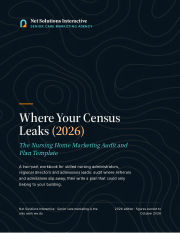
Get the free Nursing Home Marketing Audit and Plan Template (2026)
A 36-page workbook: audit where referrals and admissions slip away, then fill in a blank eight-part marketing plan with owners and review dates, sent to your work email.
Which marketing channels actually work for a nursing home?
Rank channels by the census they fill, not by how familiar they feel. The professional referral channel (liaison relationships, clinical credibility, response speed) wins skilled and short-stay rehab admissions, because those admissions are controlled by professionals and decided in hours. The digital channel (search visibility, the website, the business profile) fills long-term care and private-pay census, because those decisions start with a family and a search bar; it also quietly protects the referral channel, since a family can still strike a facility from a professional shortlist over whatever they find online.
The reputation layer (ratings, reviews, inspection history) is not a channel you post to but a gate both streams pass through. Paid advertising has a real but narrow job: capturing high-intent local searches you do not yet rank for. And community presence still earns admissions when it is pointed at professionals (the discharge desks, clinics, and agencies that refer) rather than at the general public.
The pattern administrators recognize too late: budget flows to the visible channels (print, sponsorships, a handsome brochure) while the channels that control census get whatever attention is left over. Flip that allocation and the same budget behaves differently.
What does nursing home digital marketing include?
Nursing home digital marketing is the part of the system that works while your liaisons sleep, and it is more than a website refresh. The website has to serve two readers who want different things: a referring professional looks for clinical capabilities, payer participation, and a frictionless way to send a referral; a family looks for what the building feels like, who works there, and whether the promises match the public record.
The Google Business Profile — claimed, accurate, photographed, and answered — often matters more than the website itself, because for most families the profile is the first impression. Around those two sit local search visibility (local SEO and accurate local listings) for the phrases families actually type from a hospital hallway; a review engine that invites feedback at the right moment in a discharge and responds to everything, praise and complaint alike, inside privacy rules; paid search reserved for the highest-intent local queries; and measurement plumbing underneath (call tracking and inquiry logging) so money can follow what fills census instead of what looks busy.
Which nursing home marketing ideas actually move census?
Ideas are cheap. The nursing home marketing ideas below move census because each one removes a specific point of friction between a referral and an admission.
- A referral response protocol with an owner on every shift. Referrals arrive at night, on weekends, and during shift change; a facility that can say yes or no while competitors wait for morning wins admissions without spending a marketing dollar.
- Clinical capability sheets by service line. A discharge planner deciding between facilities needs to know, at a glance, who can take the complex wound, the dialysis patient, the cardiac recovery — put it in her hands before she needs it.
- A publicized direct-admit pathway. Emergency department case managers and physician practices will route around a hospital stay if you make the path obvious and the answer fast. Under traditional Medicare a skilled stay needs a qualifying three-day inpatient stay, so a direct-admit path serves Medicare Advantage, ACO-waiver, Medicaid and private-pay admissions.
- Liaison rounds that carry new information. A visit that says “here is what changed — a new capability, a new payer contract, current availability” earns the next referral; a visit that says “just checking in” trains the desk to stop listening.
- A professional open house. Walk discharge planners, home health nurses, and care coordinators through the building and the clinical program — the audience that controls admissions, not the general public.
- A review engine tied to discharge. The families most likely to praise you are the ones finishing a good short-stay recovery; ask at that moment, and respond to every review within privacy rules.
- Same-day tour readiness. Skilled decisions close inside the hospital-hallway window; a facility that can show a family the building this afternoon beats one offering an appointment next week.
- Content that answers the hallway questions. What families ask before choosing — how rehab works, what a payer covers, what to bring, how visiting works — answered plainly on your site, is marketing that closes at the exact moment of decision.
Census pressure is always specific. It is usually one referral source, one review pattern, or one intake habit, and identifying yours takes a short conversation.
What happens to your reputation when you don’t manage it?
It gets published anyway. A skilled nursing facility is among the most publicly documented businesses in the country. CMS rates each certified nursing home it can rate, from 1 to 5 stars on Care Compare (one overall rating plus separate ratings for health inspections, staffing, and quality measures), and has published those ratings since December 2008 for the stated purpose of helping consumers and hospital discharge planners choose a facility. The health inspection rating carries the heaviest weight in the overall score.
Two facts make this decisive rather than cosmetic. First, CMS’s August 2026 Provider Information data show overall ratings spread almost evenly, with each level from 1 to 5 stars holding between 19.1% and 20.7% of the 14,563 rated facilities, so your rating genuinely separates you from the building down the road rather than blending in. Second, your staffing is not self-reported marketing copy: CMS collects daily nurse staffing from auditable payroll data each quarter and has posted it publicly since 2017, and it feeds the staffing star directly.
The audience is wider than families, and it is not browsing by choice. Federal regulation requires hospitals to assist patients in selecting a post-acute provider by using and sharing skilled-nursing data on quality measures and resource use. Your public record is therefore a required input to the discharge conversation. The facility that never replies to a review is still communicating, and it is saying nobody is home.
The star rating itself is an operations outcome; no marketing spend changes it. What reputation management controls is everything around it: whether a searching family meets a stale, unclaimed profile or a managed one; whether reviews accumulate from families who had a good discharge or only from the ones who had a bad night; whether a reply reads composed and compliant or defensive enough to confirm the complaint; whether the story beside the rating gives it context or leaves it to speak alone. Facilities that participate in their public record read differently from facilities that endure it, and both readings happen the same afternoon a discharge list goes out.
How do you build a nursing home marketing strategy?
Marketing a nursing home starts with an audit, not a campaign.
- Read your own census the way an outsider would: admissions by referral source and by payer, the service lines that actually fill, the ones you advertise but rarely admit.
- Write the referral map — the hospitals, desks, plans, and practices that feed your building, by name, with an honest note on the state of each relationship.
- Fix response before buying reach; visibility that leads to a slow answer generates admissions for your competitors.
- Bring the public record up to parity — the profile, the reviews, the website both of your audiences will check.
- Add outreach and content aimed at the specific referral desks and family questions your audit surfaced.
- Set a measurement cadence so the whole thing answers to census rather than to activity.
Then write it down. A plan on paper forces the decisions a busy administrator otherwise defers: which service lines you are actually growing, which referral desks get liaison hours, who owns the phone at night, what gets measured monthly and by whom. The document matters less for what it contains than for what it makes you decide. If you want to see the shape such a document takes before building your own, our nursing home marketing plan sample lays it out section by section.
One structural note: skilled nursing rarely stands alone. Many operators run other lines under the same parent, and each line answers to a different referral engine — which is why our home health marketing, hospice marketing, home care marketing, and assisted living marketing programs are built as separate disciplines rather than one deck with the logo swapped.
What do compliance and honesty demand from nursing home advertising?
More than most industries, because the audience includes regulators and the subject is care. The working rules are short. Never promise a clinical outcome: “recovery” and “healing” are results your clinicians cannot guarantee to a stranger’s diagnosis.
Advertise only capabilities you can staff today; a service line on your website that your building cannot actually admit is not aspiration, it is the fastest way to burn a discharge planner, and a planner burned once reroutes around you permanently — a private penalty that operates faster than any regulator. Handle reviews and testimonials under privacy law: a public reply must never confirm that a person was ever a resident, no matter what the reviewer disclosed. Use photographs of your actual building and your actual staff. Keep payer language plain and current, and follow your state’s licensure rules on how a facility may describe itself. Keep every in-service purely educational and free of anything of value: no meals, gifts, or free staff training that replaces what the facility would otherwise pay for, because the federal Anti-Kickback Statute bars anything offered to induce referrals.
Honesty compounds in this vertical. Referral sources are professionals who compare notes, and the facility that never overpromises becomes the safe call late on a Friday afternoon — which is exactly when census is won. Compliance is not the constraint on nursing home marketing; it is the competitive position.
How do you measure whether nursing home marketing is working?
Measure at the referral-source level, not the advertisement level. The questions that matter to a census: which hospitals and which individual desks referred this quarter, and how that compares to last; how referrals converted to admissions, and, more revealing, why the rest were lost, sorted into capacity, payer, clinical capability, and response speed; how long a referral waits before your facility answers; what new admissions are doing to payer mix; how long-term care inquiries move from first call to tour to placement; whether reviews are accumulating and being answered; and whether your facility surfaces when your market searches for skilled care near its hospitals.
For a regional director, the same questions run site by site — and the gap between the strongest and weakest building in a portfolio is usually a response-speed gap before it is a market gap.
Attribution deserves honesty too. A liaison visit, a rebuilt website, and a well-answered review all feed the same admission, and pretending one channel deserves sole credit produces budget decisions that starve the system. The practical test is plainer: name the referral sources that grew, name the ones that went quiet, and be able to say why. A partner who cannot walk you through that conversation is reporting activity, not results.
Get the free Nursing Home Marketing Audit and Plan Template (2026)
A 36-page workbook: audit where referrals and admissions slip away, then fill in a blank eight-part marketing plan with owners and review dates, sent to your work email.
Frequently asked questions about nursing home marketing
How is nursing home marketing different from assisted living or home care marketing?
The buyer and the clock. Assisted living and home care are chosen mostly by families over weeks or months, so those verticals reward long consumer nurture. A skilled admission is chosen mostly by a discharge professional in hours, with the family ratifying, so nursing home marketing rewards referral infrastructure and response speed first, with consumer marketing running second for long-term care census. A program copied from another vertical aims at the wrong buyer on the wrong clock.
What are the 5 key marketing strategies for a nursing home?
Five, in the order they earn budget: a referral response protocol that gives a discharge planner a clear yes or no on every shift; liaison relationships that carry new information to the hospitals, desks, and plans on your referral map; a digital presence (the website, the Google Business Profile, and local search visibility) that serves both the referring professional and the searching family; a reputation layer you take part in, with reviews invited at discharge and every one answered inside privacy rules; and measurement at the referral-source level, so the budget follows admissions rather than activity. Run them in that order, because reach bought before response is fixed generates admissions for your competitors.
What are some effective marketing ideas for assisted living?
The ideas that work for assisted living lean consumer, because a family chooses over weeks or months rather than a discharge planner in hours: a website and Google Business Profile that show what the building feels like and who works there, reviews invited at the right moment and answered inside privacy rules, content that answers the questions families ask before choosing, and a tour that can happen the day a family asks. For an operator who also runs skilled nursing, the useful idea is the split itself: run assisted living as its own program with its own measurement, because each line answers to a different buyer on a different clock.
Do we really need digital marketing if our admissions come from hospital referrals?
Yes, because the family veto happens online. A discharge planner hands over a short list; a family searches every name on it from the hospital hallway, and a facility with a neglected profile and unanswered reviews gets quietly crossed off without ever knowing it was considered. Digital presence is also the entire channel for long-term care and private-pay inquiries, which referral relationships do not produce.
Can marketing fix a low CMS star rating?
No, and an agency that implies it can is telling you something about itself. The rating reflects staffing, quality measures, and survey performance — operational levers. What marketing does around a difficult rating is keep the rest of the public record strong: accumulate genuine reviews from families who had good discharges, respond to criticism with composure and compliance, and make sure the rating is not the only thing a family or a network manager finds. Context does not overwrite the record; it keeps the record from being the whole story while operations do the real repair.
How long before marketing moves census?
On the referral side, as fast as the referral cycle itself — better response speed and clearer clinical communication win referrals you were already losing, inside normal discharge volume. On the digital side, visibility and reputation compound over quarters, not days. Anyone quoting a precise timeline before auditing your referral map and your public record is reciting a sales script, not making a forecast.
Should we hire an agency or handle marketing in-house?
Split it by what each side can actually hold. Liaison relationships belong in-house — a discharge planner trusts the person who shows up, and that person should wear your badge. The specialized layer (search, reputation systems, website and tracking, referral-facing content) is where in-house teams thin out, because those disciplines change constantly and reward full-time practice. The wrong answer is a generalist agency that learns the difference between a payer and a referral source on your invoice.
What should we look for in a nursing home marketing agency?
Disqualify before you compare. An agency that guarantees census, quotes results before seeing your referral map, or serves nursing homes alongside restaurants and roofing companies is priced to disappoint you. What remains after that filter: an agency that works only in senior care, speaks payer and referral language without translation, puts referral infrastructure ahead of ad spend, and will tell you plainly when marketing is not your actual problem.
What is the single biggest marketing mistake nursing homes make?
Marketing warmly to families while the actual buyer gets voicemail. Facilities refresh the lobby and reprint the brochure while the referral line rings unanswered on a Saturday — polishing the surface a family sees for an hour while neglecting the mechanism a discharge planner tests every week. Its close cousin: buying visibility before fixing response, which pays to generate inquiries the building then loses.
Do short-stay rehab and long-term care need separate marketing?
Yes — they are different products bought by different buyers on different clocks. Short-stay rehab is referral-driven, decided by professionals on clinical capability and speed. Long-term care is family-driven, decided on trust, and found through search and reputation. A single message aimed at both reaches neither, which is why the strategy, the web pages, and the measurement should split cleanly along that line.
What role does our admissions team play in marketing?
They are the conversion layer — every dollar and every relationship ends at their phone. An unanswered referral call is marketing budget spent on a competitor’s admission; a slow payer verification is a preferred-network relationship eroding in real time. Staff, train, and measure admissions as part of the marketing system, because to every referral source, the admissions desk is the facility.
Does word of mouth still matter for a nursing home?
Yes, in two forms. The professional form is discharge desks, hospitalists, and home health nurses comparing notes about which facilities answer, admit what they claim, and send patients home well. The consumer form is reviews — word of mouth with a permanent public record. Both are earned the same way, by the discharge going the way you said it would, and both can be encouraged deliberately instead of left to chance.
What should a nursing home operator do next?
Start with the honest read. If skilled referrals arrive faster than you can admit them, network managers keep you on their preferred lists without being asked, and families arrive at tours already convinced, you do not need a marketing partner, and if you called us, we would say so in the first conversation. A full building with a working referral engine should be left alone.
If the week looks different (referral volume that softened without explanation, a payer mix drifting the wrong way, capacity that sits empty while a competitor across town runs full, a public record you would rather a family not read), then the gap is structural, and structural gaps do not respond to another brochure.
Here is where we fit. We market senior care and only senior care — no restaurants, no software startups, no learning curve billed to you — and we work with one skilled nursing organization per market (one city or metro area), only where the referral map and the market suggest a census case worth building.
The first conversation is short and practical: what a discharge planner and a searching family each find when your building comes up, who is winning those searches, and what it would take to own them. If the case is there, the next step is a working session on your referral map. If it is not, we will say so plainly, and fifteen minutes is all it cost you. Either answer serves you. If this page described your building: Book the 15-minute market walkthrough.