

13 tactics, each tied to census you can count.
The best marketing ideas for home health are the ones you can trace to a referral you admitted and staffed. Net Solutions Interactive builds referral systems for home health operators, and the 13 ideas below are the tactical layer of that work. Competition is dense: according to MedPAC, in 2024 there were over 12,000 Medicare-certified home health agencies, and 86% of traditional-Medicare beneficiaries had at least 5 of them covering their ZIP code.
Most agency marketing fails the trace-to-admission test: a health-fair booth, a mailer, a sponsorship banner nobody reads. The prize is large: MedPAC reports that in 2024, about 2.7 million fee-for-service Medicare beneficiaries received home health care, and the program spent $16.0 billion on those services. Those counts exclude Medicare Advantage, so read them as the traditional-Medicare share of your market.
The strategy layer above this list lives in our guide to home health care marketing. If your agency also runs a private-duty line, our home care marketing ideas cover that side.
- A marketing idea earns its place only if you can trace it to an admitted, staffed referral.
- Every idea below names an owner, a cadence, and a working signal.
- Referral-source ideas move census fastest; digital ideas make every referral easier to accept.
- Start with the two free ideas: the referral criteria card and the 48-hour loop-back.
Run these five first, cheapest first:
- The referral criteria card, which costs an afternoon.
- The 48-hour loop-back, which costs a checklist.
- The two-moment review ask, which costs a conversation clinicians already have.
- The monthly in-service circuit, which costs a clinician’s half-day.
- The quarterly clinical niche, which costs real training budget.
Which referral-source ideas actually earn admissions?
Referral sources decide under time pressure and route to whichever agency removes the most risk. Each idea here makes your agency the lowest-friction choice when a referral exists.
Medicare’s discharge planning rules require a hospital that refers a patient to home health to give the patient a list of available agencies serving the area and to disclose any financial interest it holds in one. The patient chooses, so you need to be on the list with a name the family recognizes.
According to MedPAC’s March 2026 report, home health is the most common formal post-acute destination after a hospital stay, at 18.0% of traditional-Medicare discharges in the first 10 months of 2024, up from 15.8% in 2019. And eligibility runs on a clock: Medicare certification requires a face-to-face encounter within 90 days before or 30 days after the start of care, and the patient must be homebound and need part-time or intermittent skilled care.
Replace the brochure with a referral criteria card
A discharge planner needs to know within seconds whether this patient is yours. Build a one-page card: counties covered, payers accepted, clinical specialties, what you do not take, and how fast intake acknowledges a referral. The “what we do not take” line tells the planner your yes means yes. The intake manager builds it, the liaison delivers it, and it is reverified quarterly. The working signal: referrals start matching the card, and calls about payers or ZIP codes taper off.
Run a 48-hour loop-back after every start of care
A planner who refers and hears nothing remembers it at the next referral. Close the loop: within 48 hours of start of care, one named intake coordinator sends a short, privacy-appropriate confirmation: admitted, first visit completed, who to call with concerns. Every referral, on a checklist. The working signal: the second referral from that source arrives without a marketing visit, and planners call your intake line directly.
Own one hard clinical niche each quarter
Referral sources index agencies by the problems they solve. Pick one referral type your competitors bounce (complex wound care, cardiac recovery, behavioral health overlays) and build the capability first: training, protocols, a clinician on point. Then the liaison carries the message to every source. The clinical director owns the choice, one niche per quarter, never announced before it can be staffed. The working signal: a planner saying “we sent this one to you because you take these.”
Which digital and search ideas are worth running?
Most referrals are checked online before they are accepted. The planner, the physician’s office, and the family each check you online first. Digital work is the verification layer under every referral you earn.
Your two Care Compare star ratings also refresh quarterly, so every quarter is a chance to move them or let them drift.
The Quality of Patient Care rating is built from 7 measures and needs data on 5 of them to be calculated. The Patient Survey rating needs 40 completed surveys across 4 quarters; below that, the data is published without stars. The bar is high: per MedPAC, the 2024 top-box score was 85% (the share of patients rating their agency a 9 or 10) and 79% would definitely recommend it, both among traditional Medicare patients.
Build situation pages, not service pages
Families search their situation, not your service names: nursing at home after heart surgery, therapy after a stroke, wound care after a hospital stay, usually with a city attached. According to the CDC, more than 795,000 people in the United States have a stroke every year.
Build one page per situation your agency admits, in the caller’s vocabulary, with eligibility and the next step stated plainly. Intake supplies the phrasing it hears all day; the website owner writes it. One page a month, maintained rather than multiplied. The working signal: intake calls that open with the page’s situation in the caller’s own words.
Treat your Google Business Profile as an operations asset
Wrong hours or an unanswered question adds friction just as someone verifies you. Put the profile on the office manager’s calendar like payroll: service area and categories checked monthly, one post a week, and the real intake questions answered in the profile’s description and services and in your website’s FAQ. Ask every caller how they found you and log it. The working signal: the “found you on Google” line in your intake log fills in.
Publish the questions your intake team answers every week
Intake answers the same questions all week: does Medicare cover this, do we need the doctor first, how fast can visits start, what does home health do that home care does not. Make each one a page — the question as the headline, the plain answer in the first two sentences, detail underneath. Search engines and AI assistants quote answer-first pages. Intake supplies the list, marketing writes, a clinician checks accuracy, one question every two weeks. The working signal: callers arrive pre-answered.
How does education earn referrals from facilities?
Education beats promotion with clinical audiences: facility staff refer to the people who make them better at their jobs.
Keep every in-service purely educational and free of anything of value: no meals, gifts, or free staff training that replaces what the facility would otherwise pay for, because the federal Anti-Kickback Statute bars anything offered to induce referrals.
Run a monthly in-service circuit at referral facilities
A 20-minute teaching visit (fall red flags, sepsis warning signs, when a resident’s decline is a home health referral) puts your clinician in front of the people who see the candidate first. The first two topics earn the time: according to the CDC, over 14 million, or 1 in 4 older adults, report falling every year, and about 1.7 million adults in the U.S. develop sepsis each year, at least 350,000 of whom die during their hospitalization or are discharged to hospice.
Teach, do not pitch; the only selling is a closing slide with your referral line. The director of nursing or a clinical educator delivers, the liaison books the rotation, one building per month. The working signal: front-line staff start flagging candidates to you by name before the referral is written.
Present field observations to the hospital’s readmission committee
The hospital owns a readmission problem, and your clinicians see what it cannot: the first week home. Offer the care-transitions or readmission committee a short presentation of field observations — medication confusion, missed follow-ups, hazards your nurses walk in on. You arrive as a clinical partner, not a vendor. The administrator or director of nursing presents, quarterly per hospital. The working signal: you get invited back, and your name comes up in discharge conversations you were never part of.
How do you build reviews and ratings on purpose?
Reviews and public scores are read by families deciding whether to accept the referral and by professionals deciding whether to send the next one.
Ask for reviews at the two right moments
Satisfaction peaks twice in a home health episode: after a good first week of visits, and at discharge after a good outcome. The clinician the family trusts asks in person, and the office texts the review link the same day. Ask every family at those two moments, never only the ones you expect to be happy. The working signal: reviews that name a clinician and a situation, the only kind a discharge planner reads as real.
Respond to every review without ever confirming a patient
Referral sources read your review responses closely, because they show how the agency behaves when something goes wrong. Respond to every review within two business days, and never confirm the reviewer was a patient — a privacy line even a warm thank-you can cross. Speak in process terms, take specifics offline, and keep the task with the administrator. The working signal: a complaint thread that ends with the reviewer updating the review, and zero privacy incidents.
Manage the scores Medicare publishes about you
Your quality and patient-survey ratings are published whether you manage them or not. You cannot edit the score, but you can get ahead of it: a two-question pulse call mid-episode, run by the QA nurse, surfaces a problem while it is still fixable. The administrator reviews the pulse log weekly. The working signal: complaints reach your office before the public record.
What can your own staff do to bring in referrals?
Field staff meet more referral sources in a week than your liaison does, yet few agencies equip them.
Give every clinician a referral capture script
A nurse finishing a visit gets asked by a med tech, a physician’s front desk, or a neighbor: “do you all also take…?” Give every field clinician one rehearsed sentence on who the agency serves, plus a simple handoff — the intake number and a same-day callback that intake honors. The director of nursing teaches it at orientation and refreshes it quarterly. The working signal: intake log entries attributed to field staff, from sources your liaison has never visited.
Publish your staffing story as census marketing
A referral source’s worst outcome is a referral that bounces because nobody could staff it, and the labor market will not loosen on its own: according to the Bureau of Labor Statistics, employment of home health and personal care aides is projected to grow 18% from 2025 to 2035, with about 760,500 openings projected each year.
That makes recruiting and retention census marketing: publish how you onboard, how mentorship works, why your clinicians stay. One staffing story a month, on the website and LinkedIn, owned by the administrator with HR feeding material. The working signal: referral sources stop asking about capacity and trust you with harder cases.
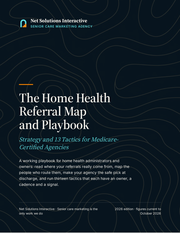
Get the free Home Health Referral Map and Playbook
A 39-page workbook to map the people who route your referrals and run 13 tactics, each with an owner, a cadence and a signal, sent to your work email.
Frequently asked questions about home health marketing ideas
What are the best marketing ideas for a home health agency with no marketing staff?
The referral criteria card, the 48-hour loop-back, and the two-moment review ask — all run by people already on payroll, all discipline rather than budget. Add the Google Business Profile routine to the office manager’s calendar and you have a working program before you hire anyone.
How do home health agencies get more referrals from hospitals?
By being the lowest-risk choice at the moment of discharge: published acceptance criteria, a response commitment intake actually honors, and a loop-back after every start of care. Planners route to certainty, and certainty is built from process, not from dropped-off pastries.
How long do these marketing ideas take to produce referrals?
Referral-source ideas move within a referral cycle or two, because they change the behavior of people who already hold referrals in their hands. Search and content ideas compound more slowly, across quarters. Judge each idea by its named working signal, not by a feeling at the end of the month.
What do these marketing ideas cost to run?
Let the intake log set the budget: fund the sources producing admitted, staffed referrals and starve the rest. Most of this list costs staff time and discipline before it costs money. The common failure is not underspending — it is paying for reach while skipping the cadence that makes any idea work.
Which marketing ideas should home health agencies avoid?
Anything you cannot trace to a staffed admission: generic event sponsorships, mass mailers to households, and purchased lead lists that sell the same inquiry to your competitors. Before spending, run the test every idea here passes: a named owner, a cadence, and a working signal.
Who should own marketing in a small home health agency?
The administrator owns the cadence; each idea has its named operator — intake owns the loop-back, the director of nursing owns education, the office manager owns the profile, and the liaison carries messages the clinical team builds. A liaison is a channel. A channel is not a plan.
How should you sequence these ideas?
These ideas fail when an agency runs all of them at half-cadence instead of three of them relentlessly. Sequence depends on your market, your referral mix, and where your census leaks — strategy work, not list work.
Senior care marketing is the firm’s entire focus, and we work with one home health agency per market (one city or metro area). Book the 15-minute market walkthrough: what a discharge planner or family finds when they look your agency up after a referral, where your agency ranks when families in your area search for care, and who is winning those searches instead. If the walkthrough shows your referral system already works, we will say so and end the call there.
Continue reading