

A daughter phoning agencies from her kitchen table after her mother’s fall will often book an assessment with the first agency that answers and asks what happened. Home care sales is everything between that call and a service agreement. Over 14 million older adults report a fall every year, the CDC says. Net Solutions Interactive works only in senior care.
Marketing makes the phone ring; sales decides whether it becomes a start of care.
Senior care is all Net Solutions Interactive does, and in home care the sales conversation is where marketing either pays off or quietly dies. Sales turns a worried family’s inquiry into a scheduled assessment, a signed agreement, and a start of care. Sales is a separate discipline from the home care marketing strategy that made the phone ring, and in most agencies the weaker of the two.
- In our experience, speed to first response decides more outcomes than anything said later: the family is phoning agencies in the order search listed them.
- Winning agencies staff intake with someone who leads the conversation and owns what happens after it, not someone who takes a message.
- Inquiries that do not convert right away are often deferred, not lost — and almost nobody works the deferrals.
- Marketing determines what sales receives: a referred or well-searched inquiry arrives half-decided before anyone picks up.
What is home care sales, and where does marketing stop?
Marketing creates the inquiry: visibility when a family searches, referral relationships that send the call, reviews that make the name trustworthy. Sales converts it: first response, assessment conversation, service agreement, caregiver introduction. The two share a pipeline and almost nothing else.
Conflating them has a cost. When census is flat, the reflex is to buy more marketing. But if the intake conversation is broken, more marketing buys more of the same silence; the leak scales with the volume poured through it. Fix the conversation first and every future marketing dollar buys more than it used to. Everything below stays on the sales side of that line.
What actually happens between an inquiry and a start of care?
A daughter has had a bad weekend: her mother fell, or a discharge date is coming. Search puts a whole market’s agencies in front of her in one afternoon, and she starts phoning from her kitchen table. The first call rolls to voicemail. At the second agency, someone takes a message. At the third, a person answers, says her name back, and asks what happened this weekend. By the time the other two call back, she has scheduled an assessment and stopped shopping.
That weekend is not rare. According to the CDC’s older adult falls data, last reviewed September 2026, falls are the leading cause of injury for adults ages 65 years and older, and over 14 million, or 1 in 4 older adults, report falling every year. Each of those falls can start a call like hers.
The third agency did not win on better care. It won on presence — and to a family in a small crisis, presence reads as reliability. In our experience, speed to first response outweighs polish, credentials, and price, because the call is the family’s first sample of the agency when something goes wrong at home.
From there the path runs through the in-home assessment, the service agreement, the caregiver match, and the first shift. Every handoff is a place where families go quiet: an assessment slow to schedule, a first shift with a stranger. The sale is not closed at the signature; a fumbled first week can undo everything. Home care sales, done properly, owns the whole path.
The caregiver match is a promise the sale makes before scheduling can keep it. According to the Bureau of Labor Statistics, employment of home health and personal care aides is projected to grow 18% from 2025 to 2035, with about 760,500 openings projected each year. Confirm the first shift can be staffed before the family hears a start date.
Why do qualified inquiries go quiet?
In our experience, in most agencies nobody is actually selling. The call lands on a scheduler or office manager between other tasks — conscientious, warm, unequipped for the moment. They collect the hours, quote the rate, offer to send information, and hang up. The file is accurate and dead.
It is not for lack of families who need care. According to the U.S. Census Bureau’s Vintage 2025 estimates, the nation’s population age 65 and older grew from 55,628,091 on April 1, 2020 to 64,617,088 on July 1, 2025, an increase of 16.2%. AARP’s 2025 caregiving report puts family caregivers at 63 million Americans, a nearly 50% increase since 2015.
The difference between that call and a consultative one is not charm. It is structure:
| Moment in the call | An intake that takes information | An intake that runs the conversation |
|---|---|---|
| The opening | “How many hours are you looking for?” | “Tell me what happened that made you call today.” |
| The subject | The schedule and the rate | The parent — the fall, the diagnosis, the load the family has been carrying |
| The rate | Quoted immediately, then silence | Quoted plainly, once the conversation has established what it buys |
| The close | “I’ll email you some information.” | An in-home assessment on the calendar |
| Afterward | Nothing, unless the family calls back | A named owner, a next action, a date |
The right-hand column is not manipulation. It is a conversation led by someone who knows the family is not buying hours; they are buying relief from a situation that has outgrown them. The information-taker is not at fault: the role was never defined, never trained, never measured. In our experience, most agencies do not have a sales problem so much as an unstaffed sales function.
How do you structure the assessment conversation?
The consultative intake has a shape — anyone willing to lead a conversation could learn it.
- Start from the event, not the request. Families call after something happened: a fall, a diagnosis, a discharge date, a spouse who finally hit a wall. “What happened that made you call today?” opens the real subject; “How many hours do you need?” closes it.
- Ask about the person before the schedule. Who is your mother? What does her day look like? What has she stopped doing lately? The family hears their parent treated as a person, not a booking — and the agency learns what the care plan will actually require.
- Let the real worry surface. The stated request is usually the negotiated-down version of the need — a few mornings a week, when what keeps the daughter awake is all the hours in between. Hear it, name it kindly, and let the in-home visit tell the truth about scope.
- Treat the assessment as the close. Not a hard close — a demonstration. Arrive exactly when promised, speak to the parent rather than over her head, notice what a professional notices, leave a specific plan in plain language. In our experience, a family that experiences a good assessment often stops comparing agencies at all.
- Quote the rate in context. A rate quoted in the opening moments is a commodity number; the same rate after a real conversation and a good assessment is the price of a specific plan for a specific person. Quote it plainly and without apology — apology signals doubt, and families hear it.
What should happen to the inquiries that do not convert?
The pattern owners misread most: an inquiry that does not become a client this month gets logged as lost, when in home care many are merely deferred. “We’re going to think about it” is often literally true: siblings have not agreed, the money conversation has not happened, the parent is still refusing help. The need has not gone anywhere; left alone, it compounds.
The money conversation can be the slowest to finish. According to Medicare.gov, Medicare doesn’t pay for 24-hour-a-day care at your home, or for custodial or personal care that helps with daily living activities like bathing and dressing when this is the only care you need. A family that learns this mid-decision may need time to work out who pays: CareScout’s 2025 Cost of Care Survey puts the national median for a non-medical caregiver at $35 per hour, or $80,080 a year at 44 hours of care per week.
Then the next event arrives (another fall, a discharge, the caregiving spouse’s own health scare) and the decision reopens overnight. The second call goes to the agency that stayed warmly, usefully in touch, not the one that logged the family as gone.
Working deferrals takes a system, not sentiment: every unconverted inquiry keeps a named owner, a next action, and a date. Each touch carries something useful (a check-in timed to the discharge they mentioned) because a message that merely asks whether they have decided teaches a family to stop answering. Done well, the deferral pipeline undercuts even fresh home care lead generation on cost, because these inquiries were already paid for.
How do referral sources change the sales conversation?
A referred inquiry is a different conversation, because the selling started before the phone rang. When a hospital discharge planner, a home health nurse, a geriatric care manager, or an elder-law attorney hands a family an agency’s name, the professional’s credibility arrives attached. The family calls half-decided; the conversation is confirmation, not persuasion.
Referred inquiries reward speed even more than cold ones — a discharge planner works against a clock, and the agency that answers now becomes the one she leads with next time. The loop back is part of the sale: a short note that the start of care happened buys the next referral; a source who never hears outcomes drifts to whoever communicates.
The hospital carries its own stake in that handoff. According to CMS, the Hospital Readmissions Reduction Program encourages hospitals to better engage patients and caregivers in discharge plans and reduce avoidable readmissions. It has reduced payments to hospitals for excess readmissions since October 1, 2012, using 30-day readmission measures, with the payment reduction capped at 3%. A discharge plan that depends on care at home is only as strong as the agency that answers.
Building those relationships is marketing — referral-source development sits alongside the other home care marketing ideas that fill the pipeline. What happens once the referred family calls is sales, and treating it like a cold inquiry is how referral relationships die.
What should an owner see in the pipeline at any moment?
An owner should be able to answer at any moment, without asking anyone: which inquiries are open, what stage each is at, what the next action is, whose name is on it, how long each has been waiting, and where each came from.
Aging is the tell: an inquiry with no next action is not in progress; it is dying politely. Source matters because inquiries behave differently by origin — the mix shows where the next marketing effort should go. None of this requires software: a whiteboard and a standing Monday review will do. The habit is the tool, not the platform.
Without that visibility, an intake loses inquiries invisibly: the owner sees the census number move (or not) and never sees the leak that produced it. Every month the pipeline stays unowned, the marketing budget keeps buying conversations nobody finishes. For an owner, this pipeline is where revenue generation actually happens, because the revenue from home care services begins at the start of care, not at the inquiry.
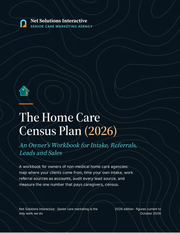
Get the free Home Care Census Plan (2026)
A 32-page owner’s workbook to map where your clients come from, time your intake and work referral sources as accounts, with fill-in worksheets for leads, sales and census, sent to your work email.
Where does marketing determine what sales receives?
The honest connection between this page and what Net Solutions Interactive does runs upstream: sales can only convert what marketing sends. A family that arrived through strong local search, credible reviews, and a referral relationship walks in half-convinced; a name from a purchased list walks in cold and stays cold. That is why qualified inquiry generation, never purchased lists, is the standard Net Solutions Interactive builds to.
The machinery that receives those inquiries — intake capture, follow-up sequences, pipeline reporting an owner can read at a glance — is marketing infrastructure, and building it is part of what a specialist home care marketing agency does. Our own reporting depends on it: what we hand a client is scored on admissions, so their intake conversion shows up on our scoreboard too. We have a selfish interest in your sales function working.
Net Solutions Interactive is not a sales trainer, and this page is not a pitch to become one. Senior care is the only work we do, and the fit is deliberately narrow — one operator per market (one city or metro area), and not every agency is a match. An owner who wants the system built and will staff the conversation could be one; an owner shopping for a vendor to blame might not be.
Frequently asked questions about home care sales
What is home care sales?
Home care sales is the discipline of converting inquiries into starts of care: first response, assessment conversation, service agreement, and follow-up on families who defer. Marketing creates the inquiry; sales converts it.
Who should own sales in a home care agency?
One named person per inquiry, whatever the title — in a small agency that could be the owner. When everyone answers the phone, nobody owns what happens after it rings.
How fast should an agency respond to a new inquiry?
Before the family reaches the next name on their list: answer live when possible, and return messages while the family is still at the kitchen table, not at day’s end. Families in a care crisis take the speed of the first answer as their first evidence of how an agency will show up at home.
Why do families say they will think about it and then go quiet?
Because the decision has usually been postponed, not made against you — siblings, money, or a parent still refusing help. The agency that stays warmly in touch is positioned for the second event that reopens the decision.
Does more marketing fix a sales problem?
No — it scales the problem. More inquiries through a broken intake produce the same conversion and a bigger leak. Fix the conversation and the follow-up first, then add volume.
How do I get private pay home care clients?
Private pay families reach an agency through local search, reviews and the professionals they already trust: discharge planners, geriatric care managers and elder-law attorneys. Medicare does not pay for custodial or personal care when that is the only care needed, so those families are working out who pays while they compare agencies. In our experience, the agency that answers first, leads the assessment conversation and gives every deferred inquiry a dated next action is the one that turns them into starts of care.
What should a home care owner fix first?
In order:
- Own the first response, so no inquiry waits while a competitor answers.
- Put one name on every inquiry.
- Give every unconverted inquiry a next action and a date.
- Then look upstream — a working intake deserves better inquiries.
Net Solutions Interactive builds this intake and follow-up machinery for owners whose job is running the agency rather than assembling its systems. Book the 15-minute market walkthrough, or build it from this page; what matters is that someone fixes the intake.
Continue reading