

Own the inquiries your presence earns; stop renting names your competitors also buy.
Home care leads are the calls, form fills, and referrals that bring some of America’s 63 million family caregivers to your agency. The term hides the split that decides whether an agency grows: an inquiry your own home care marketing produced and a name someone else captured and sold you both arrive as a phone number, and only one of them was looking for you.
- A lead’s future is settled before the phone rings: an inquiry your presence earned and a name sold to you and other agencies behave nothing alike at intake.
- Purchased lists rent volume. An owned pipeline (search presence, referral accounts, intake speed) compounds and keeps producing after spending stops.
- Judge quality before volume: provenance, exclusivity, expectation, fit, and timing decide what a lead could become, and none can be added later.
- The distance between a first call and an admission is intake work (answer speed, the first conversation, the in-home assessment), and improving it upgrades every lead source at once.
What counts as a home care lead?
A home care lead is any inquiry about non-medical care at home: personal care, companion care, respite for a family caregiver. The industry stretches the word further, and that is where owners get hurt. An inquiry through your own channels, demand built on your reviews, ranking, and referral relationships, is a lead. So, on paper, is a name a directory sold you after a form fill on its own site, then resold to every agency in your market paying the same vendor.
Same word, different products: demand for your agency, and demand for the whole category, rented out one name at a time. Every useful decision about lead generation, and about the home care marketing strategies built on it, starts with keeping the two separate.
Where do home care inquiries actually come from?
Strip away the vendors and the software and every inquiry has a provenance: someone handed it to you, or nobody did. The first is professional referral sources: hospital and rehab discharge planners, geriatric care managers, elder law attorneys, physicians’ offices, home health teams whose episodes are ending, placement advisors whose client stays home. They stand beside the family when care stops being optional, and their recommendation carries borrowed trust.
The second origin is unclaimed demand: a search no referral relationship produced and no vendor owns. Search results, and increasingly the AI answer layer above them, decide which agencies are considered. The family can run that search from anywhere: 91% of U.S. adults own a smartphone, per Pew’s mobile fact sheet. A Pew Research Center study found 18% of Google searches in its March 2025 sample produced an AI summary, and users who saw one clicked a traditional result in 8% of visits, against 15% without. Reviews decide who survives the shortlist; an agency that built for that moment inherits the inquiry.
Notice what is missing: lead vendors. A directory is not a source of demand but a middleman inside the family’s search, capturing the form fill and renting the result to whoever pays. Paying for that access can still be rational, but you are buying a copy of a relationship someone else owns, and the original does not transfer.
Why does a lead’s source predict how it converts?
Because trust and intent are settled before intake picks up. A referred family carries a professional’s credibility, so the conversation starts warm. A self-directed family arrives mid-research with real intent, having chosen your number over the others on screen. A purchased name arrives cold: the form was filled on someone else’s website, the family may not recognize your agency, and the name may already be ringing at a competitor. Nothing said on the call changes where it came from.
Owners meet this from the receiving end: a name resold across several agencies turns one inquiry into a race only the first agency to reach it wins. The rest paid for a contact competitors are already working: interruption, not demand. Run enough of those races and something quieter breaks: coordinators stop believing inquiries convert, and start leaking the referred and self-directed callers who were never cold.
Then there is the arithmetic of renting. Stop paying a vendor and the flow stops the same day, leaving nothing behind. Meanwhile the reviews not gathered, referral relationships not started, and pages never written compound for whichever agency in your market is building them. The ground is shifting too: search engines increasingly answer care questions directly and cite the agencies whose presence earned the citation. Rented volume can cover this quarter; it cannot buy back the position being settled this year.
What is the difference between renting leads and owning the pipeline?
Renting and owning is the difference between a cost that repeats and an asset that compounds. Renting is simple: pay per name or per month while the vendor keeps the website that ranks, the reviews that persuade, and the first relationship with the family; volume is its product, so exclusivity stays rare. Owning is slower: your presence ranks, your reviews persuade, your referral sources recommend, and each month’s work settles onto your home care business’s balance sheet instead of a vendor’s.
| What to compare | Purchased leads | Owned pipeline Recommended |
|---|---|---|
| Where the inquiry starts | A directory’s website, captured and resold | Your presence: search, reviews, referral sources |
| Who else receives the name | Any agency the vendor serves in your market | Nobody — the family called you |
| What the family expects | Calls from agencies they may not recognize | A call back from the agency they chose |
| What happens when spending stops | The flow stops the same day | Rankings, reviews, and relationships keep producing |
| What compounds over time | The vendor’s asset | Yours |
None of this makes a purchased list a scandal: if a list fills the schedule and the economics hold, nobody should talk you out of it. Calling or texting a purchased name is telemarketing: get the vendor’s record that the family agreed to hear from your agency, check the National Do Not Call Registry when it did not, use autodialed or prerecorded calls and texts only with prior express written consent, and follow CAN-SPAM in any marketing email.
But a list can never become a pipeline. It does not rank you, review you, or refer to you, and it stops the day you stop buying; that is what lists do. The build-versus-buy question is really about who does the building, which is what a home care marketing agency is for, provided it builds assets your agency keeps.
What is an owned home care lead pipeline made of?
Three parts, interlocking. Each is ordinary alone; the fit between them produces qualified inquiries month after month.
A local search presence built for unclaimed demand. A search that starts from nowhere lands on whoever prepared for it: a business profile with accurate categories and hours, photos of real caregivers rather than stock smiles, steady reviews answered by a human. The family on the other end of that search reads those reviews before it dials: BrightLocal’s 2026 Local Consumer Review Survey found that 97% of consumers read reviews for local businesses and 74% look for reviews written in the last three months, so a review base that stopped growing last season already reads as stale.
Behind it, service pages answer what people actually search (what care at home costs, how caregivers are screened and insured, what the first week looks like) plainly enough for a search engine or AI answer to cite. Not a project you finish; a presence you keep.
Referral-source relationships worked like accounts. Map every discharge planner, geriatric care manager, elder law attorney, and home health team whose clients need non-medical support when the clinical episode ends. Rank them by what they could send against what they do send, set a visit cadence, and hold it. Close the loop: tell each referrer what happened to the family they sent, or the referral stays a one-time favor rather than a habit. The broader list of home care marketing ideas is long; the ones worth an owner’s hour strengthen one of these three parts.
An intake that answers fast and can staff what it wins. A person, not a menu, answers during business hours, with a real plan for evenings and weekends, because families in a crisis do not schedule their urgency, and crises are common: over 14 million older adults, or 1 in 4, report falling every year, according to the CDC. Speed is measured in minutes; the first conversation centers on the family’s fear, not the agency’s form.
Behind intake stands capacity: the Bureau of Labor Statistics counts about 4.7 million home health and personal care aide jobs in 2025, with a median annual wage of $35,800, and projects 18% growth from 2025 to 2035, about 760,500 openings a year. Recruitment and retention decide whether each admission can be staffed; inquiries an agency cannot staff are the costliest success there is.
How do you judge lead quality before paying for volume?
Put five questions to any lead source, a vendor’s or your own, before spending on volume; quality is decided upstream.
- Provenance. Where was the family standing when they raised a hand — your website or someone else’s? Intent attaches to where it was expressed; it does not transfer with the phone number.
- Exclusivity. How many agencies receive the same name? Ask the vendor directly and listen for the pause. Sharing is not a defect to them; it is the business model.
- Expectation. What does the family know about your agency, and whose call are they expecting? An expected call opens an admission conversation; an unexpected one opens with an apology.
- Fit. Care type, schedule, service area, payer. An inquiry your agency cannot serve is not a cheap lead — it is unpaid intake work.
- Timing. Researching for someday, or discharging on Friday? Both are worth having, but only if the follow-up treats them differently.
Run a vendor’s product through those five and volume is often the only thing on the label. Run your own pipeline through them and they become a repair list: expectation points at your review presence, fit at your service pages, timing at your follow-up cadence.
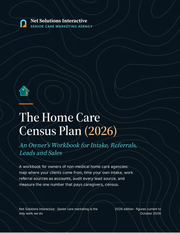
Get the free Home Care Census Plan (2026)
A 32-page owner’s workbook to map where your clients come from, time your intake and work referral sources as accounts, with fill-in worksheets for leads, sales and census, sent to your work email.
What happens between the first call and an admission?
The lead is the beginning of the work, not the end. First comes the callback race: a family working down a list stops dialing when a competent, unhurried human answers, so the agency answering first takes the assessment before the second returns the voicemail. Every hour of delay hands intent back to the market.
Then the first conversation, which is intake and the opening move of the home care sales process. The coordinator who asks about the parent by name, answers the question behind the question, and ends the call with the in-home assessment scheduled is doing sales work. The assessment is where the admission is won: in the family’s living room, matching what a caregiver will do on Tuesday morning to what the family has feared since the hospital.
When the family is not ready (the search can start well before the decision), the inquiry enters a follow-up cadence that keeps your agency present without hovering: useful answers, spaced out, from one named coordinator. An inquiry quiet in March could be an admission in June. The census arithmetic is blunt: if intake leaks, lead flow can double while census holds still. Sealing the leak is the cheapest growth available, because it upgrades every lead source at once, free ones included.
Frequently asked questions about home care leads
What is the best source of home care leads?
No single source carries an agency, but referred and self-directed families tend to arrive with the trust and intent that become admissions. The durable answer is a mix the agency owns (referral relationships plus a local search and review presence) with intake fast enough to keep what it produces.
Should a home care agency buy leads?
Buying leads can be a rational bridge while an owned pipeline gets built; the error is mistaking the bridge for the destination. A purchased name is shared demand routed through an intermediary: it stops when payment stops and builds nothing the agency keeps. Label it rent, judge it as rent, and build something permanent alongside it.
What makes a home care lead qualified?
A qualified home care lead matches the agency on care type, schedule, service area, and payer, comes from a family that expects the call, and carries real intent: care for a specific person, not prices for someday. The source sets qualification and the first call sharpens it; persistence cannot add it later.
How fast should an agency respond to a new home care inquiry?
In minutes rather than hours. A family in a care crisis may be calling down a list, and the first competent, unhurried voice tends to take the assessment. Speed matters most for self-directed inquiries, held only by the family’s own urgency, so the plan has to cover evenings and weekends.
Are shared home care leads worth the lower price?
Sometimes, if the agency goes in clear-eyed: a shared name is a race, priced low because several agencies are running it. Fast, disciplined intake might win enough races to justify the spend; without it, the agency pays to arrive second and would gain more by fixing intake first.
How does Net Solutions Interactive generate home care leads?
Through the owned pipeline this page describes: a local search and review presence built for the family’s decision moment, referral-source development worked like an account list, and conversion-built websites and intake systems that answer fast. Qualified lead generation, never purchased lists, with the admissions ledger open to the owner on a fixed schedule.
Where should an owner start with home care leads?
Separate the two products in the budget: label purchased names as rent and judge them as rent. Then pick the part of the owned pipeline your market most rewards — review presence, referral accounts, intake speed — and start building while any rented volume covers the gap. Demand is settled; the contested side is who families find, and every month the building waits, the compounding accrues to another agency’s name.
Net Solutions Interactive works with senior care operators and nobody else, and takes one operator per market, so the honest first step is finding out whether yours is open: one email, fifteen minutes on the phone, and a plain answer. If you want a vendor who sends names by Friday, we are the wrong number, and there are plenty of right ones. Book the 15-minute market walkthrough if owning the pipeline is the direction.
Continue reading