

A home care marketing agency should help you turn demand into census. Net Solutions Interactive’s owner’s manual for choosing one: mechanism over theater, census over clicks, and the questions that make a weak pitch flinch.
Senior care is all Net Solutions Interactive does, and the 64.6 million Americans aged 65 and older in July 2025, up 16.2% since 2020 according to the Census Bureau, are why the agency you hire matters. A home care marketing agency is a firm an owner hires to produce the things a full schedule never leaves time to build: qualified inquiries, working referral relationships, and a reputation that holds up when a discharge planner checks it at ten on a Tuesday morning.
Ask whether the firm selling that service has sat through an intake call, lost a caregiver to the agency across town, or explained a care plan to one of America’s 63 million family caregivers, up 20 million since 2015, according to AARP. This page is the buying manual we would hand you if you were evaluating us — because you should be evaluating us exactly this hard.
- A generalist agency learns your business on your retainer; a senior care specialist arrives already knowing how referral sources, intake, and caregiver retention pull on each other.
- The fastest question to sort agencies: explain my referral economics before you show me a deliverable. A pitch built on deliverables does not survive it.
- Mechanism beats theater. An agency that cannot walk you through its first weeks in order, and what each step changes, is selling a picture of a machine, not a machine.
- Net Solutions Interactive takes one operator per market (one city or metro area) and declines owners it cannot help; the disqualify list below is part of how we sell, not a footnote.
Why do home care owners end up firing their marketing agencies?
The failure mode has a shape. An owner hires an agency to grow admissions and, a few retainers later, owns a refreshed logo, a stack of blog posts, and a dashboard of impressions a referral source has no reason to look at. The actual work of marketing a home care agency (referral development, local visibility, intake conversion) never started. What started was activity.
The expensive part is everything the retainer did not buy. Every month the wrong agency runs, the inquiries your market produced went to whichever competitor answered first and sounded like it understood the situation. The caregivers you needed applied somewhere too. The discharge planner who tried you once and reached voicemail built her habit around a different agency. None of that appears on the agency’s report, which might be the most honest thing about the report.
The outside of a pitch (a partnership slide, a montage of logos, a promise to be data-driven) reveals almost nothing about whether anyone behind it has done the work.
Meanwhile the ground is moving: search engines now answer questions directly instead of listing links, a family can arrive having already read what is public about you, and the demographic wave keeps raising the price of being invisible. Older adults outnumbered children in almost 45% of the nation’s counties (1,411) in 2024, per a 2025 Census release, and 75% of adults 50 and older want to stay in their current homes, 73% in their communities, according to AARP’s 2024 Home and Community Preferences Survey. Choosing on gut feel and deck quality was a gamble; the stakes just went up.
What separates a senior care specialist from a generalist agency?
A generalist can be good at marketing and still be wrong for a home care agency, because the first months of a generalist engagement are education — your education of them, billed as strategy.
They learn what a referral source is. They learn that an inquiry from a hospital case manager and one from an adult daughter are different animals on different clocks. They learn, slowly, that caregiver recruitment is not a hiring chore but the ceiling on how much care you can say yes to, with the Bureau of Labor Statistics projecting about 760,500 home health and personal care aide openings a year and 18% employment growth from 2025 to 2035 — and that driving demand while intake and staffing leak is marketing a bucket with a hole in it.
A specialist arrives with that map already drawn. At Net Solutions Interactive, senior care is the only industry we serve, so the first conversation starts where your problems live: which referral sources send cases you can staff, where qualified inquiries die between first call and assessment, what caregiver churn does to your ability to grow census.
Run one clean test in every evaluation: ask the agency to describe your week before you describe it. A specialist could tell you about the case manager who only sends the cases nobody can staff, the different urgency behind a private-pay inquiry and a long-term-care-insurance inquiry, the Friday-afternoon caregiver resignation that turns a growth month into triage. If the agency recognizes your operation before you explain it, you are talking to a specialist. If it nods and takes notes, you are the curriculum.
What should an owner demand to see before signing with an agency?
Marketing services are sold on decks and bought on trust, which is backwards. Before signing anything, demand six things, and watch which ones make the salesperson change the subject.
- The first weeks, in order. Not a philosophy: a sequence. What happens first, what happens next, what each step changes, and what your side will be asked to do. An agency running a real machine can recite this without checking notes.
- Where inquiries come from. Ask directly whether they buy lists or shared leads. A purchased list is someone else’s inquiry, one a vendor can resell to several agencies at once, and it trains your intake team to chase people who never asked for you. Home care lead generation is its own discipline, and a firm that cannot explain its sourcing in plain language might prefer you not understand it.
- What gets measured. If the headline numbers are impressions, clicks, and traffic, you are buying activity. The measurement that matters is census: qualified inquiries, admissions, referral-source movement. An agency willing to be judged on census makes a different promise than one hiding behind a traffic chart.
- Reporting, in writing. What arrives, how often, and what happens when a number moves the wrong way. You are listening for whether reporting is a standing document or an improvised conversation.
- Who does the work. The people in the pitch might never touch your account. Ask who writes, who builds, who answers when something breaks — and whether senior care is their entire job or this quarter’s vertical.
- Exclusivity. Ask whether they also work for the agency across town. A firm serving competing home care providers in the same market has already chosen a side, and it might not be yours.
None of these demands is exotic. Together they force a pitch out of adjectives and into mechanism — which raises the harder problem, because theater imitates mechanism well.
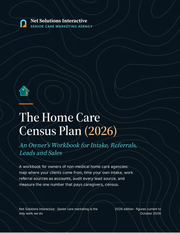
Get the free Home Care Census Plan (2026)
A 32-page owner’s workbook to map where your clients come from, time your intake and work referral sources as accounts, with fill-in worksheets for leads, sales and census, sent to your work email.
How can an owner tell mechanism from theater?
Theater is what a pitch does with no machine behind it, and its props are recognizable: award logos, a wall of industries served with no depth in any of them, the word proprietary doing unexplained work, and a strategy phase timed to the first invoice cycle.
Mechanism sounds different because it is specific about order and consequence. First the intake path gets instrumented so every inquiry is tracked from first ring to admission decision, because nothing can be evaluated until then. Then local visibility gets rebuilt around the service area, because families and discharge planners go there to verify an agency is real. Then referral development starts, because relationships compound slowest and so must start earliest. A machine has an order and a reason for the order. Theater has a vibe.
The same test sorts tactics. A long list of home care marketing ideas is raw material, not a plan. What separates a working agency is sequencing: which ideas come first for your agency, in your market, given your referral mix, and why the others wait. Anyone can hand you a list. Only a mechanism can order one.
What does working with Net Solutions Interactive look like week to week?
Kickoff is one email and a fifteen-minute call. That is the honest size of what starting requires, because the diagnostic work runs on your market, not on workshops. Owners run agencies. Long onboarding rituals are a tax on the people least able to pay it.
From there the machine runs in parallel tracks. Local search and the agency’s public footprint get rebuilt so the market can find and verify you. The website stops being a brochure and becomes an intake instrument: built for conversion, wired so every inquiry is captured, routed, and traceable. Referral-source development runs alongside, because qualified inquiries and referral relationships feed each other. Review and reputation growth turns satisfied families into public evidence. Caregiver recruitment marketing runs as its own track, because admissions you cannot staff are just disappointments with paperwork.
Reporting is a standing fortnightly briefing on the numbers an owner runs the business by: qualified inquiries, admissions, referral-source movement, what changed, and what happens next. We never buy lists or shared leads, so every inquiry we produce comes from your own presence and referral sources. And the machine has one dependency we name up front: marketing produces the inquiry, and home care sales (the intake conversation, the assessment, the follow-through) converts it. If inquiries ring late or land cold, no agency’s work survives contact with the phone.
Who does Net Solutions Interactive decline to work with?
Declining work is not a posture; it is how the machine stays honest. We take one operator per market. We cannot build referral relationships and local visibility for you and for the agency across town — every win we produced for you would be a loss we produced for them. So the market check comes first, and if your market is taken, the answer is no before the conversation starts. Either exclusivity means something or it is a slide in the deck.
Beyond geography, there are owners we turn down on fit:
- Owners shopping for purchased leads. If the request is a list, we are the wrong firm — and, gently, the list is the wrong strategy.
- Owners whose intake cannot answer. If inquiries ring to voicemail during business hours, marketing spend amplifies the problem instead of fixing it. Repair intake first; we might be useful after.
- Owners hunting a one-month miracle. Referral relationships and local visibility compound. A partner who promises otherwise is describing a slot machine, not a system.
- Owners who want a quiet vendor rather than a working partner. The engagement asks things of your side (intake discipline, sales follow-through, honest numbers), and it does not run without them.
This cuts both ways, which is the point. You are deciding whether we are the right home care marketing agency; we are deciding whether yours is an agency we can grow. The strongest engagements begin with both sides qualifying, because a firm that says yes to everyone has already told you what its yes is worth.
Frequently asked questions about home care marketing agencies
What does a home care marketing agency do?
A home care marketing agency builds the systems that produce qualified inquiries and referrals: local search, an intake-ready website, referral-source development, review and reputation growth, and caregiver recruitment marketing. A specialist measures itself on census (inquiries, admissions, referral-source movement), not on traffic.
How much does a home care marketing agency cost?
Pricing varies by market and scope, and any figure quoted before a firm has examined your market is a guess wearing a suit. The useful question is what the retainer buys: a defined mechanism measured on census, or activity measured on impressions. Insist on that distinction and the cost conversation gets honest quickly.
How is a marketing agency different from a lead vendor?
A lead vendor sells inquiries generated under its own brand, and the same inquiry can reach several agencies at once, so you pay to race competitors to a phone call. A marketing agency builds assets that belong to you — visibility, referral relationships, reputation — so inquiries arrive asking for you by name. Net Solutions Interactive builds lead generation without purchased lists, on principle.
What does a generalist marketing agency miss for a home care agency?
A generalist can be a fine choice where the subject matter is thin — a logo, a brochure, an event. For census growth, the learning curve runs on your retainer: referral economics, intake dynamics, and caregiver recruitment are not learned in a kickoff workshop. If you hire one anyway, shorten the leash: demand the mechanism walkthrough and census-based measurement, and watch how the pitch responds.
How quickly should agency marketing show results?
Unevenly, and an honest agency says so up front. Intake and conversion fixes can show movement early because they capture existing demand; local search visibility builds over months; referral relationships compound slowest and matter most. A firm promising a specific result by a specific date is reading from a script. The credible version is a defined sequence, reported in writing, each step’s effect visible as it lands.
Why does Net Solutions Interactive take only one operator per market?
Because inside a market the work is zero-sum. Referral relationships, local search visibility, and reputation are competitive positions, and building them for two competitors means quietly deciding which one wins. One operator per market keeps incentives clean: every gain lands on one census, and the owner never wonders whose side the agency is on.
Could Net Solutions Interactive be the right home care marketing agency for you?
That could go either way, and this page exists so you can tell. Run the tests on every firm you evaluate, us included: the mechanism in order, the sourcing answer, census-based measurement, the exclusivity answer — then watch which pitches survive. We work in senior care and nothing else, we take one operator per market, and your market might already be spoken for. Book the 15-minute market walkthrough if the fit reads true. If it doesn’t, don’t.
Continue reading