

Home care marketing ideas, sorted by cost, speed, and staying power.
A season of posting can leave a home care agency with an active feed and a quiet phone, while some of the 64.6 million Americans age 65 and older, up 16.2% from April 2020 to July 2025 according to the U.S. Census Bureau, call someone else. Senior care is all Net Solutions Interactive does, so we sort these ideas from the operating side of the work.
Home care marketing ideas are the individual moves (referral outreach, review generation, local search, paid ads, caregiver recruitment) that a home care agency uses to keep qualified inquiries arriving. Most guides hand an owner a flat list, as if a discharge-planner relationship and a boosted social post were the same kind of purchase. They are not: every idea has a cost in time or money, a speed to your phone, and a shelf life once you stop. This page sorts the ideas on those three axes; sequencing the winners into one system is the job of a full home care marketing strategy.
- Every marketing idea has three prices: its cost in time or money, its speed to qualified inquiries, and whether it keeps working after you stop.
- The fast ideas are mostly rented — gone the moment spend stops; the compounding ideas are slow and cannot be copied overnight.
- The time-cost ideas (referral development, a review habit, follow-up) are where a small agency out-executes a large one.
- No idea produces admissions by itself; intake speed and caregiver capacity decide what inquiries become.
Why do most lists of home care marketing ideas go nowhere?
Because they are sorted by novelty instead of economics. The typical list runs social media, a blog, an open house, a vehicle wrap — and never says which to do first, or what each costs in the only budget that is truly fixed: the owner’s hours.
So the idea that gets picked tends to be the easiest to start, not the one the census needed. Posting is easier than asking a rehab unit for its discharge planner by name, so posting wins — and a season later the agency has an active feed, a quiet phone, and a nagging sense that marketing does not work.
The deeper cost is what does not get built meanwhile. A discharge planner settles on a short list of agencies that answer fast and treat her families well: the first agency in gets the call, the rest get the overflow. Every month on the wrong idea, someone else is becoming the agency she calls.
The families behind those calls want to stay put. In AARP’s 2024 Home and Community Preferences survey of more than 3,000 adults, 75% of Americans age 50-plus said they would like to live in their current home for as long as possible.
How should an owner sort home care marketing ideas?
On three axes. First, what it actually costs: money, which can be budgeted, or your time, which cannot be replaced. Second, how soon it could reach the phone: some ideas touch professionals who already have families to place; others get found later. Third, the axis no list mentions: whether it compounds or evaporates once you stop. Run every idea through the table below.
| Marketing idea | What it mostly costs | Speed to inquiries | When you stop | What it does not do |
|---|---|---|---|---|
| Referral-source development — standing visits to discharge planners, care managers, elder law attorneys | Time, held to a cadence | Weeks for a first referral, months for a habit | Fades slowly — someone else takes the standing visit | Scale past the hours you give it |
| Google Business Profile upkeep — categories, photos, service areas | Time, in small steady amounts | Moderate — captures searches already happening | Keeps working, decays gently | Create demand; it only collects it |
| Review generation — an asking habit built into grateful moments | Time and a little courage | Gradual — trust accrues review by review | Compounds; reviews stay public | Cover for service problems |
| Local content — pages answering what families ask before they call anyone | Time or money, depending on who writes | Slowest on this list | Keeps ranking and answering | Convert the caller; that is intake’s job |
| Paid search on crisis-moment queries | Money, continuously | Immediate | Stops the same day | Build memory or preference |
| Purchased directory leads | Money, per inquiry | Immediate | Stops immediately; nothing accrues | Give you the family to yourself — the same inquiry can reach several agencies |
| Workshops for family caregivers at senior centers and libraries | Time, plus nerve at the podium | Slow and uneven | Reputation lingers; referrals fade without repetition | Attribute cleanly; the call rarely traces to the talk |
| Follow-up sequences for inquiries that did not convert | Time once, to build | Delayed by design — works when the family is finally ready | Keeps running on its own | Rescue a slow first response |
| Caregiver recruitment marketing | Time and money | Indirect — shows up as admissions you can staff | The hiring pipeline empties quickly | Create client demand; it raises the ceiling |
One pattern appears: nothing is fast, cheap, and permanent at once. The immediate ideas are rented, the compounding ideas are slow, and the affordable ideas cost the one thing an owner-operator has least of. The real decision is not which idea is best; it is which mix your home care business can carry: its census, its calendar, and its bank account.
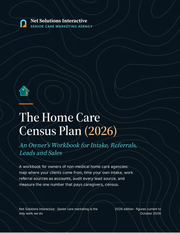
Get the free Home Care Census Plan (2026)
A 32-page owner’s workbook to map where your clients come from, time your intake and work referral sources as accounts, with fill-in worksheets for leads, sales and census, sent to your work email.
Which ideas cost time instead of money?
None of the three below can be bought outright — which is exactly why they separate agencies.
Referral-source development
The move: a named list of the people who meet families at the moment care becomes urgent (discharge planners on the hospital and rehab floors, geriatric care managers, the elder law bar, home health teams winding down an episode) with a standing visit cadence and something useful in hand every time: an availability sheet, an explainer they can give a family. What it changes: inquiries arrive pre-qualified, because a professional who knows the situation chose you before the family searched. What it does not do: scale past the hours you give it, or survive delegation to whoever is free that week. The cadence is the product.
A review-asking habit
The move: catch the moment gratitude is spoken out loud (the caregiver who stayed late, the schedule saved on short notice) and make the ask right then, with a link the family can open on the spot. What it changes: how every later family comparing agencies chooses; your profile stops being an empty storefront. What it does not do: manufacture a reputation the service has not earned. Reviews report; they do not decorate.
Follow-up on inquiries that did not convert
Families often call before they are ready — the fall has not happened yet, the family is still split, the guilt is still winning. The move: a short, warm sequence of check-ins that keeps you in the inbox until the decision arrives. What it changes: in our experience, the agency still present when readiness lands is usually the one that gets the admission. What it does not do: rescue a slow first response. Follow-up multiplies intake; it cannot replace it.
Which ideas cost money, and what does the money buy?
Paid search
Paid search buys position at the crisis moment, when a daughter searches the same afternoon the hospital says her father cannot go home alone. She has plenty of company: AARP and the National Alliance for Caregiving counted 63 million Americans as family caregivers in 2025, a nearly 50% increase since 2015. It is the fastest idea here and the most perishable: inquiries could start the day the campaign does and stop the day the spend does, building no memory and no preference. Treat it as a bridge while the compounding ideas take root, not as the plan.
A conversion-built website
A conversion-built website is money spent once on an asset that works unattended: pages that answer what families ask, a visible phone number, a form short enough to finish on a phone. It changes the share of visitors who become inquiries; it does not bring the visitors — a beautiful site nobody finds is a brochure in a drawer.
Hiring specialists
Hiring specialists buys sequencing and accountability — someone whose job is knowing which of these ideas your market rewards, and in what order. Whether to hire a home care marketing agency is a judgment call of its own; plenty of owners with time and appetite should run this list themselves first. No hire substitutes for an owner who will not pick up when a referral source calls back.
Which ideas compound, and which stop when you stop?
This axis decides what your marketing is worth down the road: sort every idea into owned or rented.
Owned assets compound. Published reviews stay public, a page that answers a family’s question keeps answering it, and a discharge planner’s trust carries into next month without being re-bought. Work done this year still works next year, so the same effort could buy more census over time.
Rented attention stops. Paid clicks end with the budget, and purchased directory leads are the clearest case: you pay per inquiry for a family that filled out someone else’s form, and the same inquiry could reach several agencies at once — a race on callback speed and price. Some months that trade is worth making. Building home care lead generation you own (inquiries that asked for you by name) is the slower move that ends the racing.
The quiet danger: rented channels feel productive while the compounding assets stay unbuilt.
What turns marketing ideas into admissions?
Two unglamorous things that never appear on idea lists: the intake conversation and caregiver capacity.
Every idea above ends the same way, with a phone ringing, and what happens next sets the value of all of it. Who answers, how fast, whether they ask about the family’s situation or recite a services menu. A strong home care sales process multiplies every idea on this page; a weak one quietly hands your marketing spend to your competitors.
Capacity is the other gate. Marketing that outruns staffing produces apologies instead of admissions — the inquiry arrives, no caregiver is free to staff it, and the family calls the next agency. That is why caregiver recruitment marketing belongs on the idea table: recruiting and caregiver retention are census work. In our experience, the agency that can say yes this week usually wins the tie, and this market runs on ties.
The labor numbers explain why. According to the U.S. Bureau of Labor Statistics, home health and personal care aides held 4,677,100 jobs in 2025, employment is projected to grow 18% from 2025 to 2035, and about 760,500 openings are projected each year, on average, over the decade. The median annual wage was $35,800 in May 2025. Every one of those openings is a caregiver some agency has to recruit before it can say yes to a family.
Frequently asked questions about home care marketing ideas
What is the most effective marketing idea for a home care agency?
In our experience, for most agencies, referral-source development — standing relationships with discharge planners, care managers, and elder law attorneys. They meet families at the moment care becomes urgent, so their referrals tend to arrive better qualified than any ad click, and the relationship keeps producing without new spend.
How can a home care agency market itself without a big budget?
Spend time where money is short: a named referral-source list with a standing visit cadence, a review-asking habit tied to grateful moments, a complete Google Business Profile, and follow-up for inquiries that were not ready yet. Those four cost discipline rather than dollars, and all four compound.
Do paid ads work for home care agencies?
They do exactly one job well: putting your agency in front of a family during the crisis search. They are immediate, controllable, and rented — inquiries stop when the spend stops. As a bridge while compounding channels take root, they earn their keep; as the whole plan, they never stop billing.
Should a home care agency buy leads from directories?
Only with clear eyes: a purchased lead is usually shared, so the same family could be hearing from several agencies at once, and the contest becomes callback speed and price. Buying can carry a slow month; owned inquiry sources end the dependence. Calling or texting a purchased name is telemarketing: get the vendor’s record that the family agreed to hear from your agency, check the National Do Not Call Registry when it did not, use autodialed or prerecorded calls and texts only with prior express written consent, and follow CAN-SPAM in any marketing email.
Which home care marketing idea should an owner start with?
Referral-source development, held to a weekly cadence the agency can sustain without heroics. A referral-source cadence run consistently beats a larger campaign run twice and abandoned, because referral relationships reward reliability more than they reward scale.
What should a home care owner do next?
Turning these ideas into marketing strategies starts small: pick one compounding idea and one fast one, and hold the pair for a season before judging either. For most owners that means referral-source development as the anchor, the business profile and review habit alongside, and paid search only if the schedule has room for admissions the compounding work has not produced yet. The sorting is the easy part; keeping the cadence when the week gets loud is the actual marketing.
Senior care is the only work Net Solutions Interactive does, and it takes one operator per market (one city or metro area) — where a market is taken, it stays taken. If your referral sources are loyal and your schedule is full, you do not need any of this bought for you: keep the list and run it. Book the 15-minute market walkthrough, or run the list yourself.
Continue reading