

An owner can double the marketing spend and see nothing move. Home care is where we watch that gap between what agencies spend and what they get back run widest, and home care marketing is the work of closing it: making your agency the obvious choice in its own service area. At Net Solutions Interactive, senior care is our only field, and demand for it is not in question: 75% of Americans age 50-plus would like to live in their current home for as long as possible, according to AARP’s 2024 Home and Community Preferences survey.
The choice itself is made by the families searching in the middle of a crisis, and by the discharge planners, case managers, and physicians who decide where a referral goes on a Tuesday afternoon. It is not advertising. Advertising is one line item inside it, and usually not the line item that moves census.
- Home care demand has two headwaters, not ten. Professional referral sources, and the family’s own search. Every channel you can buy is a tributary of one of those two.
- The compounding work is slow and the fast work is rented. Both have a place; owners get into trouble when they fund only one and expect the other’s behavior from it.
- Intake decides what your marketing is worth. An agency that answers in minutes converts inquiries an agency that answers in days never sees again.
- Census is the only honest scoreboard. Traffic, impressions, and lead counts can all rise in a month where you started no new clients.
What is home care marketing?
Home care marketing is everything that causes a qualified inquiry to arrive and a start of care to follow. That definition is deliberately wide, because the narrow definition (running ads and posting on social media) is what leaves owners confused about why spending more produced nothing.
Marketing home care services covers the agency’s presence in local search, the relationships it holds with professional referral sources, the reputation visible to a family who has just been handed three agency names, the website that either answers a worried person’s question or does not, and the intake process that turns the resulting phone call into a scheduled assessment. Some of that is bought. Most of it is built.
The distinction matters because the two behave differently over time. Bought presence stops the day the invoice stops. Built presence keeps working, gets cheaper per inquiry as it matures, and is difficult for a competitor to take from you. Most agencies that feel stuck have been buying for years and building for none.
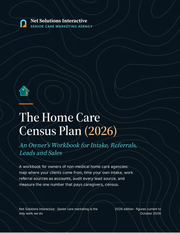
Get the free Home Care Census Plan (2026)
A 32-page owner’s workbook to map where your clients come from, time your intake and work referral sources as accounts, with fill-in worksheets for leads, sales and census, sent to your work email.
Why does home care marketing work differently from other senior care marketing?
Home care is bought under different conditions than any other senior care service, and the differences are not cosmetic.
The decision is usually made in a hurry, by an adult child, after an event — a fall, a discharge, a diagnosis, a caregiver who quit. The person searching is rarely the person receiving care. They are frightened, working from incomplete information, and comparing options in an afternoon. They are not running a considered purchase process, and copy written as though they are will not land.
The pressure behind those calls is large and growing. Over 14 million older adults, or 1 in 4, report falling every year, according to the CDC. The U.S. population age 65 and older rose by 16.2% to 64.6 million from April 2020 to July 2025, according to the Census Bureau, and older adults outnumbered children in almost 45% of U.S. counties (1,411) in 2024, per a 2025 Census release. And the people making the call are a large group: AARP and the National Alliance for Caregiving count 63 million American family caregivers, a nearly 50% increase since 2015.
The service is also delivered inside someone’s house by an hourly caregiver, which means your capacity to say yes is your capacity to staff. An agency can market its way to more inquiries than it can serve, and doing so is worse than useless: a family that calls, is told you can start in three weeks, and hangs up will not call back, and they will tell the referral source who sent them.
The workforce behind that capacity has to grow quickly. According to the Bureau of Labor Statistics, home health and personal care aides held 4,677,100 jobs in 2025, employment is projected to grow 18% from 2025 to 2035, and about 760,500 openings are projected each year, at a median wage of $17.21 per hour.
And the buyer is frequently not the payer. Private duty home care is often paid out of family funds, which puts a price conversation into the first or second call and makes trust do work that a brochure cannot do for you.
The sums are real. Medicare does not pay for custodial or personal care when it is the only care a person needs, and CareScout’s 2025 Cost of Care Survey puts the national median for a non-medical caregiver at $35 per hour, or $80,080 a year at 44 hours of care per week.
Put those together and the strategy that follows is specific: be present where the search happens, be credible before the call, be fast when the phone rings, and never outrun your ability to staff.
For home care marketing, where do clients actually come from?
Two headwaters. Everything else is a tributary.
The first is the professional referral source — hospital discharge planners, skilled nursing case managers, hospice liaisons, elder law attorneys, geriatric care managers, physicians and their office staff, and the placement advisors who work a territory. These people send business to the agency they trust, and referral marketing in home care is the slow work of earning that trust out of unglamorous things: answering when called, taking the difficult case, staffing the weekend, and closing the loop so the referrer learns what happened to the person they sent.
The second is the family’s own search. A daughter three states away types a question into her phone at eleven at night. What she finds, or does not find, decides whether your agency is on her list of three.
Notice that a purchased lead list is not a third headwater. It is a toll booth on the second one: someone else built the search presence, captured the inquiry, and is reselling it, often to you and to two competitors at once. That is a legitimate thing to buy, and it is not the same product as an inquiry your own presence produced. The difference between renting and owning that pipeline is the whole subject of home care lead generation, and it is where most marketing budgets are decided well or badly.
How do you build a home care marketing plan?
A home care marketing plan is not a list of tactics. It is a sequence, and the order carries most of the value.
- Start with intake Everything upstream of a broken intake is waste. Establish how fast a first call is answered, who answers it, what they say, what happens to an inquiry that does not convert on the first contact, and whether the owner can see the status of every open inquiry without asking anyone. Fix that first. It costs the least and returns the most, and it is the one improvement that makes every other investment worth more.
- Establish the presence the family’s search lands on That means the agency’s online presence in the towns it actually serves: its local search footprint, a site that answers a family’s questions in the order they ask them, and a review profile that reflects the care you actually deliver rather than the three complaints that happened to get written down.
- Work the referral sources as accounts, not a mailing list Know who they are, what each one needs, what you promised, and what you delivered. This is a cadence, not a campaign.
- Buy reach, and only fourth Paid search, paid social, sponsorships, print, to accelerate a machine that is already converting. Buying reach first is the common and expensive mistake, and it is why an owner can double spend and see nothing move.
If you want the individual moves sorted by what each costs and how fast it pays, the home care marketing ideas page sorts the marketing ideas home care agencies actually use side by side.
Which home care marketing strategies compound and which ones rent?
The same split governs every home care strategy: each falls into one of two families, and confusing them is the source of most disappointment.
| Criterion | Rented | Compounding |
|---|---|---|
| What counts as one | Paid search, paid social, purchased lists, sponsored placements | Local search presence, a review habit that runs every month, referral relationships worked consistently for a year, content that answers the questions families actually ask |
| How it behaves | Produces inquiries while you pay, and stops when you stop | Slow to start, then gets better on its own |
| Month one | Fast and measurable | Nothing impressive |
| Month eighteen | Does not accumulate | Difficult to displace |
| When to reach for it | You need volume this month, or you are testing whether a new territory has demand at all | You want a permanent line that a competitor cannot easily take from you |
Private duty care leans especially hard on the compounding family, because private-pay families research more before they call.
The practical answer for most agencies is not to choose. It is to fund the compounding work as a permanent line and use the rented work deliberately — to cover a soft month, to open a new county, to fill a specific shift pattern you are short on. The failure mode is treating rented spend as the strategy and wondering why nothing accumulates.
What does home care advertising include, and does print still earn its place?
Home care advertising is the bought portion: paid search, paid social, local sponsorships, radio in some markets, and print. Online advertising earns the first dollar of bought spend for a plain reason — the family’s search happens online, and paid search reaches a person at the moment of intent rather than hoping to catch them earlier. Service area targeting keeps that spend inside the towns you can actually staff, because an inquiry from beyond your caregivers’ reach is a call you have to turn away.
Print has not disappeared, though its job has changed. Home care marketing brochures are now mostly a referral-source tool rather than a consumer one. A discharge planner who has ninety seconds and a family who needs to choose today will hand over something physical. A brochure that survives that moment is specific (service lines, coverage area, how fast you can start, who to call) and not a glossy statement of values. The same logic governs a home care marketing print program: leave-behinds, in-service materials, and one-pagers that make a referrer’s job easier are worth their cost; general-awareness print rarely is.
The honest test for any advertising line is what you could still point to, three months after switching it off, that it had produced. If the answer is nothing, it was never the thing producing your census.
How does intake decide what your marketing is worth?
Two agencies can run identical marketing and get entirely different results, and the variable is almost always what happens after the phone rings.
Speed is the first factor and the one owners underestimate. A family in the middle of a crisis reads a fast answer as reliability and a slow one as a preview of the service. They are usually calling more than one agency, and the order in which calls are returned decides more outcomes than the content of any of them.
Who answers is the second factor. An intake coordinator who collects information is not the same as one who runs a consultative conversation — who asks what happened, understands what the family is actually afraid of, and moves the conversation toward an in-home assessment rather than a price quote. That is a learnable structure, and it is what separates agencies with similar inquiry volume and dissimilar admissions. The mechanics of that conversation are the subject of home care sales.
The third factor is what happens to the inquiries that do not convert immediately. A meaningful share of home care decisions are deferred rather than lost — the family was planning ahead, or the hospital sent them home with more support than expected, or they tried to manage it themselves for another six weeks. An agency with a follow-up habit captures those. An agency without one pays to generate the same inquiry twice.
You don’t need all of this at once. You need to know which piece is short in your market, and finding that out takes a short conversation.
How do you measure home care marketing?
Measure census. Everything else is a leading indicator that can drift the wrong way while census stays flat.
Traffic can rise because you ranked for something no buyer searches. Inquiry counts can rise because a lead vendor turned up the volume on a list that does not convert. Impressions rise for almost any reason. None of those pay caregivers.
The measurements worth reporting to an owner are: how many qualified inquiries arrived, where each one came from, how many became scheduled assessments, how many became starts of care, and what happened to the ones that did not. Sourcing matters more than volume, because source predicts conversion — a referral from a case manager who knows you arrives pre-sold, and a resold list name does not.
A reporting rhythm that an owner can actually act on beats a dashboard nobody opens. Ours is a written report twice a month, measured on census rather than clicks, which is enough to catch a problem while it is still small and infrequent enough that nobody is writing reports instead of working.
Who should run your home care marketing?
There are three honest answers, and which one fits depends on the agency rather than on what any agency would like to sell you.
Some owners should run it themselves. If your home care business serves one county, you know your referral sources personally, and your inquiry volume is a number you can hold in your head, a disciplined owner working a simple cadence will outperform a disengaged vendor. What you need in that case is the sorting, not the service.
Some should hire in-house. Once there is enough volume to keep someone busy and enough process to hand over, an internal marketer who lives in the business has advantages no outside firm can match.
Some should hire a specialist. The case for that is narrow and worth stating plainly: you want the compounding work done properly and consistently, you do not want to build the capability internally, and you want someone who has seen how this goes wrong in senior care specifically rather than in dentistry or home services. If you are weighing that decision, the home care marketing agency page sets out what to demand before signing anything, including from us.
We take a small number of home care agencies, one operator per market (one city or metro area), because the work only produces what it should when we are not competing with ourselves. That means we say no to agencies in a market we already serve, to owners who want purchased lists rather than an owned pipeline, and to anyone who needs census to move next month — that is not what the compounding work does. If any of that describes the situation, we are the wrong firm and it costs nothing to know that now.
Get the free Home Care Census Plan (2026)
A 32-page owner’s workbook to map where your clients come from, time your intake and work referral sources as accounts, with fill-in worksheets for leads, sales and census, sent to your work email.
Frequently asked questions about home care marketing
What is home care marketing?
It is everything that causes a qualified inquiry to arrive and a start of care to follow — local search presence, referral-source relationships, reputation, the website, and the intake process that converts the resulting call. Advertising is one part of it, and usually not the part that moves census.
How do home care agencies get more clients?
By working the two sources that actually produce them: professional referral sources worked as ongoing relationships, and the family’s own search, met with a local presence that a family in a hurry can find and trust. Then by answering fast enough to convert what arrives.
How do home care agencies get paid?
Private duty home care is paid mostly out of family funds, with some business from long-term care insurance, VA benefits and Medicaid waiver programs, because Medicare does not pay for custodial or personal care when that is the only care a person needs. Medicaid rates usually lag private pay, so payer mix shapes an agency’s margin, and the price conversation arrives in the first or second call. That is why trust has to be earned before the phone rings.
How do you market a home care agency with a small budget?
Fix intake first, because it costs the least and makes everything else worth more. Then work referral sources, which costs time rather than money and is the ground where a small agency beats a large one. Buy reach only once those two are converting.
What should a home care marketing plan include?
A sequence rather than a tactic list: intake and follow-up first, then local search presence and reputation, then a referral-source cadence, then bought reach to accelerate what already converts. It should also name what you will stop doing.
Do home care marketing brochures still work?
As a referral-source tool, yes — a discharge planner with ninety seconds hands a family something physical, and a specific one-pager survives that moment. As general consumer awareness, print rarely earns its cost anymore.
How long does home care marketing take to work?
It depends entirely on which kind you buy. Rented reach produces inquiries within days and stops when you stop paying. Compounding work (local presence, reviews, referral relationships) shows little early and becomes difficult to displace over a year or more.
How should a home care agency measure marketing results?
On census. Count qualified inquiries by source, scheduled assessments, starts of care, and what happened to the inquiries that did not convert. Traffic and lead counts can rise in a month where you started no new clients.
What should a home care owner do next?
If one thing on this page is worth acting on this week, it is the intake audit — time your own response to an inquiry, listen to what gets said, and find out what happens to the families who do not convert on the first call. Most owners find something there that costs nothing to fix and changes what every other dollar is worth.
If the compounding work is the part you would rather not build yourself, that is the conversation we have. Nothing else is on our desk but senior care, we work with one home care operator per market.
Book the 15-minute market walkthrough, or run the plan yourself. Either works.
Other care lines we market
Operators who run more than home care will recognize the same four systems at work across these lines, with the buyer, the regulations, and the permitted language changing line by line.