

Hospice demand hit a record in 2024: 52.9% of Medicare decedents elected hospice, according to MedPAC, while the number of providers competing for those patients grew 2.6%. Hospice marketing decides which programs earn those referrals first, and Net Solutions Interactive builds those systems for one hospice per market (one city or metro area). The work runs through the referral relationships, digital visibility, and community trust that keep a census growing.
- More than 1.8 million Medicare beneficiaries received hospice care from about 6,700 providers in 2024, and Medicare hospice spending reached $28.3 billion.
- Referral relationships, not advertising, drive most hospice admissions; more than a quarter of hospice decedents enroll only in the last week of life.
- The highest-return marketing work is earning earlier, better-qualified referrals, then converting them faster than competing programs.
- Every claim in a hospice campaign must survive compliance review: regulators actively revoke providers whose growth outruns their eligibility discipline.
What is hospice marketing?
Hospice marketing is the set of activities a hospice uses to earn referrals, admissions, and community standing: physician and facility outreach, digital presence, reputation management, and community education. Unlike consumer marketing, marketing for hospice is mostly business-to-business: the buyer of your message is usually a clinician, not a patient.
That structure changes everything about how you market hospice services. A physician who refers to you is staking professional credibility on your care quality, so hospice care marketing succeeds on proof (response times, symptom-management outcomes, survey scores) rather than slogans.
The operator’s job is to treat marketing as a census function with its own pipeline: referral sources identified, educated, converted, and retained. Every section below maps to one stage of that pipeline.
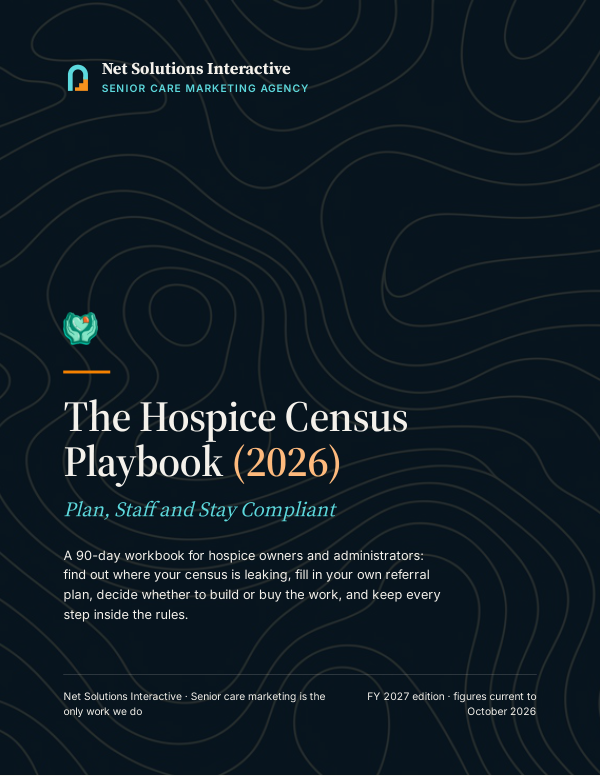
Get the free Hospice Census Playbook (2026)
A 40-page workbook to plan, staff and stay compliant on referral development, with fill-in 90-day plan worksheets, sent to your work email.
Why does hospice marketing matter more in 2026?
The market is growing, and so is the number of hospices competing for it. According to the Medicare Payment Advisory Commission’s March 2026 report, 1.82 million Medicare beneficiaries received hospice services in 2024, a 4.6% increase over 2023, while total days of care rose 7.7% to about 148 million.
“The share of decedents using hospice increased to 52.9 percent in 2024, up from 51.7 percent in 2023, reaching a new high.” — Medicare Payment Advisory Commission, March 2026 Report to the Congress
Supply is expanding alongside demand. MedPAC reports the number of hospice providers grew 2.6% in 2024, with for-profit hospices growing about 5%; roughly 82% of providers are now for-profit, and they serve 60% of Medicare hospice patients.
Medicare hospice spending rose 10.4% in a single year, to $28.3 billion in 2024. More providers chasing a richer benefit means the hospices that grow are the ones that market deliberately — and the ones that stand still lose referral share to newer entrants.
Where do hospice referrals actually come from?
Hospice referrals come overwhelmingly from upstream clinicians: attending physicians, hospital discharge planners, skilled nursing facilities, and assisted-living communities, supplemented by families acting on a clinician’s recommendation. Your referral mix is your revenue mix, so mapping it is the first real marketing task.
The dominant pattern in that pipeline is lateness. According to MedPAC, more than one-quarter of hospice decedents enroll only in the last week of life, and the median lifetime length of stay among 2024 decedents was just 19 days — against an average of 99.6 days.
Setting matters as much as diagnosis. MedPAC’s 2024 data shows average length of stay of 174 days for patients in assisted-living communities and 120 days in nursing facilities, versus 100 days for patients at home, which is why facility relationships anchor most hospice growth plans.
The marketing implication is direct: the biggest census gains come not from finding new referral sources but from earning earlier referrals from existing ones. That is a clinician-education problem, and it is exactly what a structured physician referral marketing program is built to solve.
How do you market hospice to physicians?
Physician outreach is the highest-leverage work in hospice marketing, and it is not advertising. Under the CMS Medicare Benefit Policy Manual, only a medical doctor or doctor of osteopathy can certify terminal illness, so every Medicare admission runs through a physician’s certification. Anyone can start the conversation; one professional closes it. That makes physician education the gate on your census, not a channel sitting alongside the others.
The gate opens late, as the median stay above shows. Referring clinicians are rarely withholding hospice on purpose — they are waiting for a certainty the eligibility criteria never required. The work is replacing that hesitation with a trigger list they can recognize at the bedside.
What physicians need before they refer. Three things, in order: clarity on who qualifies today, confidence you will answer when they call, and evidence of what happened to the last patient they sent. Lead with eligibility recognition for the diagnoses they actually manage. Follow with a response standard you can keep every time: a stated window from referral to bedside evaluation. Close the loop with a short note back on admission and outcome. A referral source who never hears the outcome has no reason to build the habit.
What a working liaison program looks like. Start from an account map, not a call list: rank every physician group, hospital discharge team, skilled nursing facility, and assisted-living community by the volume they could send against the volume they do. Set a visit cadence per tier and hold it. Give the liaison one measurable promise to carry (the response standard) and the authority to keep it.
What compliant outreach looks like. The federal Anti-Kickback Statute prohibits remuneration to induce referrals of federal health care program business, and the OIG’s Compliance Program Guidance for Hospices (1998) names the specifics: per-certification fees, free or below-market services to referral sources, and reviewing residents’ records without permission to solicit referrals (patient charting) are all flagged risk areas. The same guidance requires marketing materials to feature the benefit’s eligibility requirements prominently, and never to imply the terminal prognosis is of limited importance. Teaching eligibility is the growth strategy that is also the compliant one; buying influence is neither.
How to measure it. Track admissions by named source, never in aggregate. Watch three numbers per source: referrals sent, median length of stay on the patients they send, and your own response time to their calls. Rising volume with falling length of stay means you are winning later referrals — real revenue, but not the win worth optimizing for. Rising volume with stable or rising length of stay means the eligibility education landed. That is the number that compounds.
Most hospices do not have a physician outreach problem; they have a follow-through problem. The account map is the easy part, the response standard is the hard part, and the reporting loop is the part almost nobody keeps. Building that system and measuring it by source is the work we do.
Which marketing channels work best for a hospice?
No single channel carries a hospice marketing strategy. Referral outreach produces admissions fastest, digital marketing determines whether families and clinicians can validate you, and community marketing compounds slowly into preference. The comparison below shows how the three channel families divide the work.
| Channel | Primary audience | Time to census impact | Cost profile | What it does best | Its limit |
|---|---|---|---|---|---|
| Physician and referral-source outreach | Physicians, discharge planners, skilled nursing and assisted-living staff | Weeks — the shortest path to admissions | Liaison salaries and clinical education time | Earlier, better-qualified referrals from clinicians who already control patient flow | Scales only with relationship headcount; compliance rules constrain incentives |
| Digital marketing | Families researching options and clinicians vetting your program | Months — visibility builds, then converts continuously | Website, local search, content, and review management | Being found and trusted at the moment of decision; validating every offline referral | Rarely creates demand by itself in a clinician-driven market |
| Community and event marketing | Seniors, caregivers, faith and civic groups, veterans organizations | Quarters — reputation compounds slowly | Staff time, sponsorships, grief-support programming | Name preference before the crisis moment; goodwill that softens the hospice conversation | Hard to attribute; produces awareness, not immediate referrals |
Strong programs sequence the three: referral outreach funds the near term, digital marketing converts and validates, and community work lowers resistance to the hospice conversation over years. Weighting them is a strategy decision, covered below.
What does hospice digital marketing include?
Hospice digital marketing covers the owned surfaces a referral source or family checks before choosing you: your website, local search listings, service-line content, and reviews. Its job is validation as much as acquisition — a discharge planner who hears your name will look you up before sending the next patient.
The website must answer clinician questions (eligibility criteria, response times, service area, levels of care) and family questions (what hospice covers, what happens first) in plain language. Pages that answer one question each, with visible dates and named authorship, are the pages search engines and AI answer engines find easiest to cite.
Reputation is now a public dataset. Families and referral partners can compare hospices on Medicare’s Care Compare, which publishes survey and quality scores, so your review strategy has to include monitoring the government’s scorecard, not just commercial review sites.
Local search completes the layer: accurate listings, service-area pages, and steady review generation from families who volunteer to share their experience. In a market where more than half of decedents now choose hospice, the program that is easiest to find and verify collects a disproportionate share of self-directed inquiries.
Most hospices staff referral outreach internally but lack the specialist time digital work demands. That is the natural place to bring in outside help: an agency that works only in senior care, such as Net Solutions Interactive, can run the digital layer while your liaisons stay in the field.
Most hospices do not need more ideas. They need to know which referral relationship is quietly costing them census this quarter: one working session finds which one, and tells both of us whether there is work worth doing together.
Which hospice marketing ideas actually grow census?
The best hospice marketing ideas concentrate on referral velocity and trust, not novelty. Each one below works on referral velocity or trust, the two levers the rest of this guide measures:
- Clinical in-services for referral sources. Teach eligibility recognition — the earlier a clinician spots hospice-appropriate decline, the earlier the referral arrives.
- Facility partnership programs. Structured education and rapid-response commitments for the assisted-living and nursing-facility settings where stays run longest.
- Same-day admission capability, marketed explicitly. Referral sources reward the program that relieves them fastest.
- Grief-support and caregiver workshops. Community education that builds preference before the crisis, and keeps your clinicians visible between referrals.
- Veteran recognition programs. A differentiator many facilities value.
- Family review and testimonial pathways. A respectful, opt-in process that converts satisfied families into public proof.
- National Hospice and Palliative Care Month campaigns. November gives you a calendar reason for media outreach, open houses, and referral-source appreciation — creative hospice month ideas work best when they honor patients rather than promote the brand.
One discipline separates marketing tips for hospice that work from those that stall: every idea must name the referral behavior it changes. An event that changes nothing upstream is community relations, not marketing.
How do you build a hospice marketing strategy?
A hospice marketing strategy is a written plan that ties channels to census math and sets your competitive positioning against the other hospices in your service area. Building one takes six steps:
- Baseline the data. Twelve months of referrals by source, conversion rate, admission velocity, length-of-stay mix, and payer mix.
- Map and tier referral sources. Identify who sends, who could send, and who stopped sending — then assign liaison time by potential, not habit.
- Define positioning. The two or three provable claims (response time, specialty programs, survey scores) that differentiate you in your service area.
- Set the channel budget. Weight referral outreach, digital, and community work against the census gap you must close.
- Enlist the whole staff. Every nurse, aide, and chaplain interaction shapes the surveys and word of mouth your marketing quotes later — marketing-aware clinicians are the cheapest growth asset a hospice owns.
- Schedule measurement. Monthly source-level review, quarterly strategy adjustment.
Staff involvement deserves emphasis because it is the step operators skip. Liaisons open doors, but bedside teams determine whether a facility’s second referral ever comes.
You do not need to design the document from scratch — start from our hospice marketing plan template and adapt the tiers and targets to your service area.
What compliance rules govern hospice advertising?
Hospice marketing operates under scrutiny most industries never face. The federal Anti-Kickback Statute prohibits offering anything of value to induce referrals of Medicare patients, which rules out the gifts, paid referral arrangements, and incentive schemes common elsewhere; liaison programs must sell on education and service, never remuneration.
Accuracy rules are just as binding. Marketing may never promise services beyond the benefit, and admissions driven by growth targets rather than eligibility show up in the data regulators watch: MedPAC reports a live-discharge rate of 19.1% in 2024, and about 28% of hospices exceeded Medicare’s aggregate payment cap in 2023 — patterns it flags as signals of enrolling ineligible patients.
Oversight has teeth. According to the HHS Office of Inspector General, more than 80% of hospices surveyed from 2012 through 2016 had at least one deficiency, and over 300 (18% of those surveyed in 2016) had a serious deficiency or a substantiated severe complaint.
Enforcement is accelerating: MedPAC notes that under enhanced-oversight reviews of newly enrolled hospices in Arizona, California, Nevada, and Texas, CMS had revoked Medicare enrollment for 122 of 668 reviewed providers as of June 2025. The lesson for marketers is simple: compliance review belongs inside the campaign process, because growth built on aggressive admissions is growth a regulator can take back.
Which hospice marketing tools does the team need?
Hospice marketing tools matter less than the discipline behind them, but five categories are foundational. A referral-source CRM to log every liaison contact and tie it to subsequent referrals. Call tracking and website analytics to attribute inquiries to channels.
Add review monitoring across commercial platforms and Care Compare, a survey dashboard so marketing claims stay anchored to real satisfaction data, and a monthly referral report that puts source-level conversion and velocity in front of leadership. Tools only pay for themselves when someone owns the numbers they produce.
Choose systems your team will actually maintain. A simple spreadsheet reviewed every Monday outperforms an expensive platform nobody updates, and the reporting habit matters more than the software behind it.
How do you measure hospice marketing results?
Measure hospice marketing against census economics, not activity counts. The core metrics: referrals by source, referral-to-admission conversion rate, admission velocity (hours from referral to admission), average daily census, length-of-stay mix, and live-discharge rate as a quality guardrail.
The economics reward speed and earliness. Medicare’s average payment to hospice providers was about $191 per day in 2024, according to MedPAC, so a referral that arrives one week earlier, appropriately, represents roughly $1,340 in additional payment for that patient alongside a full additional week of care delivered.
Earlier referrals also serve the mission: MedPAC observes that enrolling only in the last week of life is commonly thought to be less beneficial to patients and families than enrolling earlier. Census growth and better care are the same argument made to two audiences.
Length-of-stay mix deserves its own line on the dashboard. MedPAC found that just over 60% of 2024 Medicare hospice spending (more than $17 billion) went to patients whose stays exceeded 180 days, so the balance of referral settings and diagnoses you cultivate largely determines your revenue profile.
Watch the cap while you grow. Medicare limits aggregate annual payments per beneficiary; the fiscal year 2026 cap is $35,361.44 under the CMS FY 2026 final rule, which also raised payment rates 2.6%, an estimated $750 million increase. A marketing program that skews admissions toward very long stays therefore creates repayment risk, not just revenue.
Get the free Hospice Census Playbook (2026)
A 40-page workbook to plan, staff and stay compliant on referral development, with fill-in 90-day plan worksheets, sent to your work email.
Frequently asked questions about hospice marketing
Fundamentals
Is hospice marketing cost-effective?
Yes, when it targets referral velocity. With Medicare paying hospices an average of about $191 per day in 2024 per MedPAC, a marketing program that produces even a handful of earlier, appropriate referrals each month can cover a liaison’s cost in added days of covered care.
Is hospice lucrative?
It can be, and referral timing decides it, not the size of the benefit. Medicare hospice spending reached $28.3 billion in 2024 and the average payment was about $191 per day per MedPAC, yet the median lifetime stay among 2024 decedents was just 19 days and more than one-quarter of decedents enrolled only in the last week of life, so a late referral brings only a few days of covered care. Just over 60% of that spending went to patients whose stays exceeded 180 days, which is why the referral settings and diagnoses you cultivate largely determine your revenue profile. The cap limits the other end: at $35,361.44 per beneficiary in fiscal year 2026, a census skewed toward very long stays creates repayment risk. The hospices that earn well grow earlier, appropriate referrals across a balanced length-of-stay mix.
What does a hospice marketer do?
A hospice marketer — usually titled liaison or community educator — builds relationships with referring clinicians and facilities, teaches eligibility recognition, communicates the hospice’s response times and quality scores, coordinates admissions handoffs, and tracks which sources refer. The role is clinical education and account management far more than advertising.
Referrals and channels
How do hospices get referrals?
Most hospice referrals come from physicians, hospital discharge planners, skilled nursing facilities, and assisted-living communities, with families initiating some directly. Because MedPAC finds more than one-quarter of hospice decedents enroll only in the last week of life, educating those clinical sources to refer earlier is the biggest growth lever.
Who can refer a patient to hospice?
Anyone can start the conversation — a family member, nurse, or discharge planner. But according to the CMS Medicare Benefit Policy Manual, only a medical doctor or doctor of osteopathy can certify terminal illness, so every Medicare hospice admission ultimately runs through a physician’s certification.
When should a physician refer a patient to hospice?
When the prognosis is a life expectancy of six months or less if the illness runs its normal course, per CMS. In practice referrals run late: MedPAC reports the 2024 median enrollment was just 19 days before death.
Does a patient need their own doctor to elect hospice?
No. According to Medicare.gov, the hospice doctor and the patient’s regular doctor — if the patient has one — certify terminal illness. When there is no attending physician, the hospice medical director’s certification stands on its own under the CMS manual.
Strategy and compliance
What are the rules for hospice advertising?
Hospice advertising must be truthful about covered services and eligibility, and the federal Anti-Kickback Statute bars giving anything of value to induce Medicare referrals. Regulators actively police growth patterns: CMS revoked Medicare enrollment for 122 of 668 newly enrolled hospices reviewed in four states as of June 2025.
Can a hospice pay physicians for referrals?
No. According to the HHS Office of Inspector General, the Anti-Kickback Statute prohibits paying remuneration to induce referrals of federal health care program business, and OIG hospice guidance specifically flags per-certification fees and free or below-market services to referral sources.
Can hospice liaisons review nursing facility records to find eligible patients?
Not without permission. The OIG’s hospice compliance guidance identifies reviewing residents’ medical records without patient permission to solicit referrals — called patient charting — as an improper solicitation practice and a named fraud risk area.
What should hospice marketing materials include?
According to the OIG’s Compliance Program Guidance for Hospices, marketing materials should prominently feature the Medicare hospice benefit’s eligibility requirements, and marketing statements should never imply the terminal prognosis is of limited importance or that benefits run indefinitely.
Measurement
How do you measure hospice marketing results?
Track referrals by source, referral-to-admission conversion, admission velocity, average daily census, and length-of-stay mix, reviewed monthly at the source level. Pair growth metrics with guardrails (live-discharge rate and aggregate-cap exposure) so marketing wins never come from admissions that fail eligibility scrutiny later.
What should a hospice operator do next?
Hospice marketing in 2026 is a referral-pipeline discipline backed by digital proof: map your sources, educate them to refer earlier, make your quality verifiable online, and measure everything against census economics. The record 52.9% hospice-use rate means the demand exists — the contest is over which program earns it.
Start with the twelve-month referral baseline, then build your plan from the hospice marketing plan template and give your physician referral marketing program its own targets. If you would rather have us build the system with you, Book the 15-minute market walkthrough; if your referral sources already refer early and your intake converts them fast, we will say so and end the call there. Senior-care marketing is the only work we do.
Where to go next
Three companion pages carry the parts of this system that need their own depth: the plan template gives you the structure to write the plan, hospice marketing regulations sets out what outreach is and is not allowed, and outsourced hospice marketing covers what changes when you buy the system instead of building it.
Operators running more than one line of care will find the same machine described for home care marketing, home health marketing, assisted living marketing, and memory care marketing.