

Most hospices that miss a census target do not lack demand; they lack a referral system that starts producing before the date on the target.
Outsource hospice marketing when the census target has a date on it and the in-house capacity does not. With a record 52.9% of Medicare decedents electing hospice in 2024, per MedPAC, demand is not the constraint. That is the whole decision, and it is an arithmetic one: a liaison you hire starts producing after a search, an offer, a notice period, and a ramp, while a program you buy starts on contract. Net Solutions Interactive runs hospice marketing programs for operators who would rather buy the system than build it.
What does it mean to outsource hospice marketing?
It means handing the whole growth function — referral development, digital visibility, intake conversion, and the reporting that proves any of it worked — to a firm whose only work is senior care marketing. Not a contractor writing posts. Not a liaison you hired and hoped would figure out search. A system with an owner.
The alternative most hospices actually run is a liaison carrying a territory, a website nobody updates, and a spreadsheet that stops being filled in by month three. That is a liaison doing a hard job alone, not a marketing program.
When should a hospice outsource instead of hiring?
Three conditions make outsourcing the cheaper answer. First, when the gap is capability rather than hours — a liaison cannot build local search presence no matter how many accounts they visit. Second, when the census target has a date on it, because hiring and ramping a marketer takes longer than most growth plans allow. Third, when nobody in the building can tell you which referral source produced last month’s admissions, which means the measurement layer has to be built before anything else pays back.
Hire in-house instead when your referral relationships are already strong, your digital presence already converts, and what you need is more face time in accounts you can name.
What should an outsourced hospice marketing program include?
At minimum: a referral-source account map ranked by potential against actual volume, a response standard you publish and keep, local search and reputation work that puts you in front of families and discharge planners at the moment of need, an intake path that converts an inquiry into a scheduled evaluation, and monthly reporting by named source rather than in aggregate.
Inside that program, the digital layer runs as four working channels, and each one earns its place by feeding a referral source the account map already names.
Search engine optimization (SEO) and local search come first. When a discharge planner checks your name before sending a patient, or a family searches for hospice care after a hard conversation with a physician, your Google Business Profile, service pages and reviews decide whether that inquiry reaches your intake line or a competitor’s. The work is built around the service area your admissions actually come from.
Content marketing is the education referral sources actually read: eligibility guides a physician’s office can hand to a family, short explainers on when a hospice conversation is appropriate, and pages that answer the questions your liaisons hear in every account. Written from your clinicians’ real eligibility conversations, it does the teaching a liaison cannot fit into a short visit.
Social media marketing keeps your hospice in front of the community and the facility staff who refer between liaison visits: staff recognition, community events, volunteer stories and the education pieces above, published on a calendar rather than whenever someone remembers. Every post that features a patient or family runs through your consent and privacy process first.
Video content carries what text struggles to: a medical director explaining eligibility in plain terms, a nurse walking through what the first visit looks like, a social worker answering the questions families ask most. One short clip works on your website, in a liaison’s follow-up email and on your social channels at once.
All four report into the same monthly read by named referral source, so you can see which channel is producing admissions and cut the one that is not. That tie to the referral map is what separates a program from a bundle of channels.
If a proposal does not name the response standard and the reporting cadence, it is selling activity rather than growth. Ask for both in writing before you sign anything. Our full hospice marketing guide lays out the same system in detail, and the plan template turns that system into a document you can hold a vendor to.
How is outsourced hospice marketing kept compliant?
The same way in-house marketing is, only with the rules written into the engagement. Remuneration paid to induce a referral is a crime under the federal Anti-Kickback Statute wherever a federal health care program is footing the bill, per the HHS Office of Inspector General. OIG hospice compliance guidance then itemizes the risk areas by name: fees paid per certification, services handed to referral sources at no charge or under market rate, and combing resident charts inside a facility without permission in order to solicit referrals.
An outsourced partner who cannot explain those three risks in their own words is a liability, not a vendor. The hospice marketing regulations page sets out what compliant outreach actually looks like.
The demand backdrop is not the problem: hospice use reached a record share of Medicare decedents in 2024, according to MedPAC. The constraint is whether your referral sources hear from you before they hear from someone else.
What does outsourced hospice marketing cost?
Price it against the admission, not the invoice. MedPAC puts Medicare’s 2024 hospice payment at roughly $191 for every day of care, and the same 2024 decedent cohort ran a median stay of only 19 days beneath a mean of 99.6 days. Add even a few clinically appropriate referrals a month that arrive earlier than they do today, and the covered days can repay the engagement; we check that arithmetic against your market before quoting.
That arithmetic is why we will not quote a retainer before we have seen your market. If the numbers do not work, we will tell you on the call rather than after the contract.
How do you evaluate a hospice marketing partner?
| Decision factor | Build in-house | Outsource |
|---|---|---|
| Gap is face time in named accounts | Stronger fit | Weaker fit |
| Gap is local search and reputation | Weaker fit | Stronger fit |
| Census target has a fixed date | Hiring and ramp add months | Program starts on contract |
| Referral sources not measured by name | Measurement built last | Measurement built first |
| Compliance depth on the hospice benefit | Depends on the hire | Written into the engagement |
Start with focus. A firm that lists hospice alongside dentists, gyms, and law firms is learning your regulatory environment on your budget. The Medicare hospice benefit has eligibility rules, certification requirements, and marketing restrictions that no general agency carries in working memory, and the cost of learning them late is not a bad campaign — it is a compliance exposure.
Then check what they measure. Ask to see a sample monthly report. If it leads with impressions, sessions, or rankings and never reaches admissions by named referral source, they are reporting activity. The report you want leads with referrals by named source, the median length of stay those patients ran, and how fast your own team answered when that source called. Those three numbers tell you whether the education landed or whether you are simply winning later referrals. Length of stay is there to show which sources refer late, so your education reaches them sooner; it is never a basis for paying liaisons or choosing patients.
Finally, test the compliance conversation. Ask directly how they keep outreach inside the Anti-Kickback Statute. A partner who answers with specifics — nothing paid per certification, nothing donated or discounted for a referral source, no chart review without permission — has read the guidance. A partner who says “we stay compliant” has not.
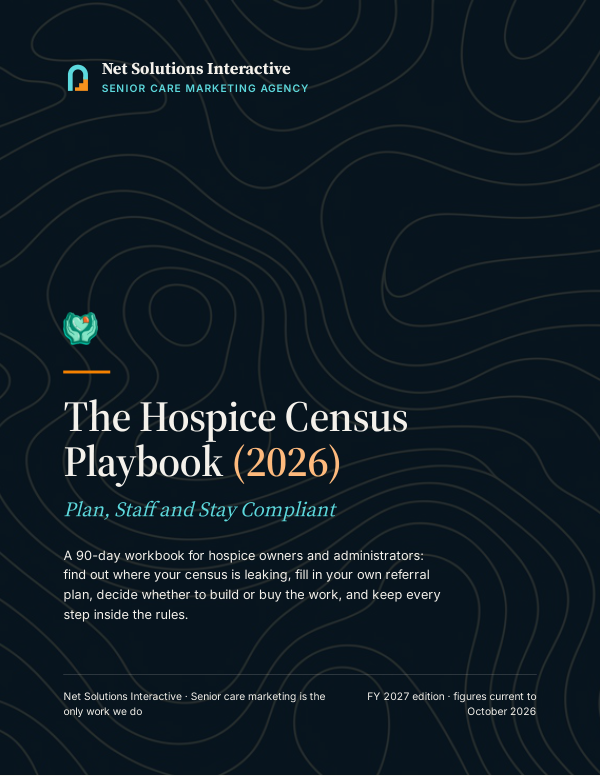
Get the free Hospice Census Playbook (2026)
A 40-page workbook to plan, staff and stay compliant on referral development, with fill-in 90-day plan worksheets, sent to your work email.
What does the first 90 days look like?
The first month is measurement and mapping, not campaigns. Every referral source gets ranked on the gap between what it sends today and what it could send, your current digital presence gets audited against the operators actually ranking in your service area, and the intake path gets walked end to end as a family would walk it. Most operators discover their weakest link is not visibility at all — it is what happens between an inquiry arriving and someone calling it back.
The second month builds the fixes: local search and reputation work, materials that lead with eligibility recognition rather than brand language, and a response standard the team can actually keep every time. The third month is the first honest read on whether referral behavior is moving, because that is the earliest point at which the education has had time to reach the people who sign certifications.
Anyone promising admissions in week two is describing a campaign, not a system. Where a patient lives also changes how long hospice care lasts: among Medicare hospice decedents in 2024, MedPAC measured average stays of 174 days in assisted living and 120 days in nursing facilities, against 100 days at home. Those figures describe patients who qualified for the benefit — every admission still rests on a physician’s prognosis of six months or less — and a census weighted toward long stays raises exposure to Medicare’s aggregate cap, which MedPAC estimates about 28 percent of hospices exceeded in 2023. The accounts you open in the first 90 days decide which referral sources reach your intake line for quarters afterward.
Frequently asked questions
Is it legal to outsource hospice marketing?
Yes. Nothing prohibits engaging an outside marketing firm. What is prohibited is paying anyone — in-house or outsourced — to induce referrals of Medicare business, per the Anti-Kickback Statute. Structure the engagement as payment for services rendered, never as a share of admissions.
Can an outsourced firm replace a hospice liaison?
No, and a partner who claims otherwise is overselling. Liaisons carry relationships in person. An outsourced program builds the visibility, materials, measurement, and intake path that make those visits land — and tells the liaison which accounts to visit first.
How long before outsourced hospice marketing produces admissions?
Referral outreach can move admissions inside a quarter because it works existing relationships. Local search compounds over quarters rather than weeks. Any timeline promised without seeing your market is a guess dressed as a commitment.
Is hospice a lucrative business?
Hospice runs on a per diem Medicare benefit, so its finances turn on whether eligible patients are referred in time to receive the care that benefit covers. MedPAC puts Medicare’s 2024 hospice payment at roughly $191 for every day of care, yet the median stay ran only 19 days beneath a mean of 99.6, so a referral that arrives in the last days of life covers only a few days of care. Setting changes the picture too: MedPAC’s 2024 averages run 174 days in assisted living, 120 in nursing facilities and 100 at home, but every admission still rests on a six-month prognosis, and censuses heavy with long stays are the ones most likely to exceed Medicare’s aggregate cap. That is why the economics run through the referral system an outsourced program is bought to build.
What should a hospice ask a marketing agency before signing?
Ask which other hospices they serve and in which markets, what the response standard is, how referral sources are reported, and who owns the accounts and data if the engagement ends. The last one separates partners from vendors.
Does outsourcing hospice marketing risk the brand sounding generic?
It does when the partner writes from templates. It does not when the materials are built from your own referral data, your own response standard, and the eligibility conversations your clinicians actually have. Ask to see copy written for another hospice and judge whether it could be swapped between providers without anyone noticing.
The bottom line
Outsourcing hospice marketing is a decision about where the growth system gets built, not about who sends the emails. If your census target has a date on it and nobody in the building can name last month’s top referral source, buying the system is faster than building it.
We take on hospice operators ready to handle the volume, one per market (one city or metro area). No retainer is quoted before we have read your market with you. Book the 15-minute market walkthrough, or build it in-house — either works.
Continue reading