

A referral your agency loses has somewhere else to go the same afternoon: per MedPAC, in 2024, 86% of traditional Medicare beneficiaries lived in a ZIP code served by 5 or more home health agencies. Home health care marketing is the discipline of winning and defending the referral relationships, public reputation, and intake responsiveness that keep a Medicare-certified agency’s census growing. Net Solutions Interactive is a senior care marketing agency, and senior care is the only trade we practice. MedPAC also counts about 2.7 million traditional Medicare beneficiaries who received home health care in 2024, $16.0 billion in program spending, and over 12,000 certified agencies competing for that work.
It is not advertising in the consumer sense, because almost nobody shops for skilled nursing visits the way they shop for a dentist — a professional routes the patient, and a family confirms or vetoes the choice. This page lays out how we think about home health marketing (where referrals actually originate, which channels deserve budget, what compliance permits, and how to know whether any of it is working), so you can judge whether your agency’s growth runs on a marketing system or on habit. The MedPAC figures throughout describe traditional fee-for-service Medicare, not Medicare Advantage.
- Home health referrals are won at the level of individual discharge planners, case managers, and physicians; you market to named people with routines, not to an audience.
- Referral response speed is itself marketing: every slow or declined acceptance trains the referrer to start with the next agency on the list.
- Digital presence rarely originates a home health referral, but it decides whether the referral you were handed survives the family’s first search.
- Census growth you cannot trace to a specific referral source, program, or channel is luck — and luck does not survive a staffing crunch or a new competitor.
Three guides, three different buyers
What is home health care marketing, really?
Home health care marketing serves two decisions made by two different people. The first is the routing decision: a discharge planner, case manager, or physician chooses which agency receives the referral, and they choose on clinical trust, geographic coverage, and a memory of how your agency handled the last one. The second is the consent decision: the patient and family, handed a name or a short list, look you up and decide whether to say yes.
Home health agency marketing is every system that influences those two moments: referral-source development, intake responsiveness, reputation, the website the family opens at the kitchen table, and the follow-through that keeps a referrer sending. In home health, lead generation is mostly referral generation: the lead that matters arrives from a named professional, and the family’s own search confirms it. Notice what is absent from that list: billboards, mass mailers, brand campaigns. The buyer is not “the community.” The buyer is a specific professional under time pressure and a specific family in a hard week, and everything on this page follows from that.
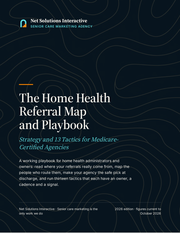
Get the free Home Health Referral Map and Playbook
A 39-page workbook to map the people who route your referrals and run 13 tactics, each with an owner, a cadence and a signal, sent to your work email.
Why is marketing a home health agency harder than it used to be?
Three structural shifts changed the market. First, hospital systems consolidated, built or bought their own post-acute agencies, and narrowed their preferred-provider lists; the open referral market your agency grew up in has been fenced. Second, referrals moved onto electronic platforms that let a discharge planner see how quickly each agency responds. Third, quality became public: star ratings and patient-survey results sit online where both the case manager and the family can see them before you ever get a phone call.
The numbers behind those shifts are unforgiving. Per MedPAC, in 2024, 97% of traditional Medicare beneficiaries lived in a ZIP code served by 2 or more agencies and 86% in one served by 5 or more, so a referral you lose has somewhere else to go the same afternoon. Agency supply grew by over 870 agencies from 2019 to 2024, but that growth came entirely from California — everywhere else supply fell about 1% per year. And payment is tightening: CMS finalized a net 1.3% aggregate reduction, about $220 million, for calendar year 2026.
Layered over all of it is staffing. According to the Bureau of Labor Statistics, employment of home health and personal care aides is projected to grow 18% from 2025 to 2035, and about 760,500 openings for those aides are projected each year, on average, over the decade.
An agency that declines referrals because it cannot staff them is running marketing in reverse: each declined case teaches the referrer to stop calling, and that lesson outlasts the staffing shortage that caused it. Relationship-only marketing was sufficient when the relationship was the whole picture. It no longer is.
Where do home health referrals actually come from?
Map them by role, because each role decides differently. Hospital discharge planners and case managers decide fast, under census pressure of their own, and reward the agency that answers, accepts, and confirms without being chased. Hospitalists and primary care physicians decide in the exam room and reward the agency that closes the loop — orders confirmed, start of care reported back, changes flagged. Specialty practices (orthopedics, cardiology, wound care) refer in predictable patterns tied to procedures and diagnoses, which makes them the most plannable accounts you have. Skilled nursing facilities refer at discharge back to the community, usually decided in a care conference days before it happens.
Then there are the settings next door: assisted living communities and memory care programs whose residents can qualify for skilled visits where they live. Marketing to communities is its own discipline (we cover it separately in our assisted living marketing and memory care marketing guides), but as referral sources they belong on your map. Finally, prior patients and their families refer quietly and permanently; they are the only source your competitors cannot call on.
Which marketing channels actually work for home health?
Ranked by mechanism, not fashion. Referral-source development comes first: a liaison calendar built around named accounts, carrying clinical substance (program capabilities, how you handle wound vac cases, what your nurses do when a patient declines) rather than pastries and a brochure. Second, intake as a channel: the phone answered by a person, referrals accepted or honestly declined quickly, after-hours coverage that exists in practice and not just on paper. Referrers market for you when your intake makes them look good to their own bosses.
Third, reputation: reviews, ratings, and the story your recent patients tell, because every professional referral now passes through a family’s search bar on its way to a signed consent. Fourth, local digital presence (covered below), which converts and validates. Community education and events earn their keep only when they feed named relationships. Mass advertising sits last for a reason: it cannot create a hospital discharge, and it speaks to people who are not yet in the moment of need.
What does digital marketing for home health include?
A website that speaks to both deciders. Referrers need service lines, coverage area, accepted payers, and how to send a referral — findable in seconds, because that is how long they will look. Families need plain answers to the questions they actually type the night after discharge: what home health is, whether Medicare pays for it, what happens at the first visit, how it differs from hired caregivers. An agency site that answers those questions in the family’s own vocabulary earns the yes that the discharge planner set up.
Around the site: a Google Business Profile that is claimed, accurate, and reviewed; pages for each community you serve so you surface where you actually staff; a review pipeline built into your discharge workflow; and call tracking wired in so you know which page produced which inquiry. Digital is the proof layer of home health marketing: it rarely starts the referral, but it decides whether the referral survives contact with the internet.
Part of that proof layer is not yours to write. Every certified agency carries two separate star ratings on Care Compare, refreshed quarterly — a Quality of Patient Care rating built from 7 measures and posted since 2015, and a Patient Survey rating posted since 2016 that requires 40 completed surveys across 4 quarters before stars appear at all. Nationally in 2024, per MedPAC, 85% of patients rated their agency 9 or 10 out of 10 and 79% would definitely recommend it, which is the comparison a case manager is making when they look at yours.
Which home health care marketing ideas actually grow census?
Most home health care marketing ideas fail for one reason: they are not attached to a named referral source or a measurable moment. The home health marketing ideas worth funding fall into four categories. Ideas that make referring easier — anything that removes a step, a form, or a follow-up call from the referrer’s day. Ideas that make trust visible — proof a family can find and a case manager can defend. Ideas that shorten the distance from referral to start of care — because speed is the one message every referrer receives. And ideas that reactivate dormant sources — accounts that used to send and quietly stopped, which is where recovered census hides.
Judge every tactic by the category it serves and the named account it touches. We keep a full working list of home health marketing ideas, sorted into those four categories; this page stays at the level of which categories pay and why.
Referral share is won agency by agency and planner by planner. If you want to know where yours is leaking before you spend anything, that is a short conversation.
How do you build a home health marketing strategy?
Most strategy lists online start with channels. Start with your own data instead, and build in this order:
- Read the concentration. Pull last quarter’s referrals by source: if a small set of accounts produces most of your admissions, your first priority is not growth; it is defending those accounts while you widen the base.
- Name your positioning. Name what your clinical team is genuinely strong at (wound care, cardiac programs, orthopedic recovery, fall prevention) and build your referral conversations around it, because “we do everything” is what every competitor says.
- Draw the referral map. Named accounts, named roles inside them, a contact cadence, and an owner for each relationship.
- Fund the channels. Only after that do channels get budget, each one assigned to a job the map defines.
- Set a capacity gate. Marketing must never outrun staffing, because a solicited referral you decline damages you more than silence would have.
Home health care marketing strategies that skip the map and jump to tactics produce activity, not admissions.
What does compliance demand from home health marketing?
Three disciplines, none optional. First, the Anti-Kickback Statute: nothing of value is offered or paid to induce or reward referrals, which shapes liaison conduct, gifts, lunches, and any arrangement with a physician practice. The line is brighter than most sales cultures assume, and your liaisons need to know where it is before they need to know anything else. Second, privacy: no patient story, photo, or identifiable detail in any marketing without written authorization, and review responses that never confirm the reviewer was a patient at all — thank, invite offline, stop.
Third, eligibility honesty. Home health admission requires homebound status, a need for part-time or intermittent skilled care, and a plan of care that a physician or allowed practitioner establishes and certifies after a face-to-face encounter within the 90 days before or the 30 days after care begins. Marketing promises admission to no one, because eligibility is a clinical determination, not a sales outcome. Two related facts are worth correcting when a referrer misremembers them: Medicare requires no prior hospital stay for home health, and the beneficiary pays nothing for covered services, though durable medical equipment carries 20% coinsurance.
Treat this discipline as an asset. Referrers have been burned by agencies that promise everything and staff half of it; the agency that says “here is exactly what we can take and when” becomes the one they trust with the cases that matter.
Which tools does a home health marketing team need?
Fewer than the vendors say, wired together better than most agencies have them. A CRM that treats referral sources as accounts — named contacts, visit notes, last-touch dates — so relationship knowledge survives a liaison’s resignation. Referral tracking tied to disposition: admitted, or not admitted and why, because a pile of referrals you could not convert is a different problem from a shortage of referrals. Call tracking configured with privacy in mind, so you know which channel the family used without recording what should not be recorded. A review platform that asks at the right moment in your discharge workflow. A website your team can edit without filing a ticket.
Then one dashboard that joins referral, admission, and source data in one view. The tool stack matters less than the habit: a CRM full of accounts nobody has visited is a subscription, not a strategy.
How do you measure home health marketing results?
Measure by named source, never by totals. Total referral volume can rise while your best account quietly leaves — totals hide the story. Track referrals by source and by program; referral-to-admission conversion with non-admit reasons split into eligibility, capacity, and lost-to-competitor, because each demands a different fix; time from referral to start of care, which is the metric referrers experience directly; and dormancy — a source whose referrals stop is a flag to act on this week, not a line item to notice at quarter’s end.
On the digital side: review velocity and rating trend, inquiries by page and service line, and which searches produce family contacts. Then the monthly question that makes it all useful: which named relationships produced admissions, which stalled, and what specifically changes next month because of it. If the meeting cannot answer that, the meeting is reporting, not marketing.
Get the free Home Health Referral Map and Playbook
A 39-page workbook to map the people who route your referrals and run 13 tactics, each with an owner, a cadence and a signal, sent to your work email.
Frequently asked questions about home health care marketing
What is the most effective marketing a home health agency can do?
The most effective marketing a home health agency does is referral-source enablement: making it operationally easier and professionally safer for a specific discharge planner, physician, or facility to send you the next patient. Everything else (website, reviews, content) exists to protect and convert what that work produces. If budget forces a choice, fund the relationship system first and the proof layer second.
How is home health marketing different from home care marketing?
Home health is skilled, ordered by a physician or allowed practitioner, Medicare-covered, and routed by professionals; the referrer is the primary buyer and the family holds the veto. Non-medical home care is usually private pay and chosen directly by families, which makes it a consumer sale with a longer shopping window and a different channel mix. The two playbooks overlap less than agency owners expect, which is why we keep a separate home care marketing guide.
We also run a hospice line — can one marketing playbook cover both?
No. The referral trigger, the conversation, and the family’s state of mind are different, and referrers judge the two service lines separately even when one agency runs both. Shared infrastructure (CRM, website platform, review tooling) is fine; shared messaging is not. The hospice side has its own referral mechanics, which we cover in our hospice marketing guide.
How long does it take for marketing to produce referrals?
Referral relationships convert on events, not calendars. A discharge planner changes agencies when something breaks their routine — the incumbent declines a case, a readmission embarrasses them, a new specialty program solves a problem they carry. Your marketing’s job is to be credibly present before that moment arrives, because you cannot schedule it. Digital assets behave differently: they compound, and they start working the day a family searches your name.
Do I need to hire a marketer for my home health care agency?
The honest test is who, by name, runs your structured account cadence — named sources, scheduled touches, clinical talking points, notes that outlive the person. If no name comes to mind, the work is not happening, because it cannot be done from the administrator’s chair between surveys and payroll. Whether the answer is a liaison on staff or an outside marketer for a home health care agency depends on your market’s size and your bench — but somebody must own the map, by name.
Should a home health agency run Google Ads?
Sparingly, and only with clear eyes about the mechanism. Paid search captures demand that already exists (a family searching after a discharge conversation), and it cannot create a hospital referral. It can defend your brand name from competitors bidding on it and catch families comparing their short list. If your referral engine is weak, ads will not fix it; they will document its weakness at a cost.
How do we get more reviews without violating HIPAA?
Build the ask into the workflow — a consistent invitation to every patient family at discharge, made by the clinician the family already trusts — rather than chasing reviews in batches. Then respond to every review without ever confirming the reviewer was a patient: thank them, speak to your standards generally, and take anything specific offline. Patient stories in marketing require written authorization, every time, no exceptions for grateful families who “won’t mind.”
What makes a discharge planner switch agencies?
A failure by the incumbent, witnessed while a credible alternative was already in view. Slow acceptance, a declined case at the wrong moment, a family complaint that lands on the planner’s desk — these open the door, and the agency that has been quietly present with clinical substance walks through it. This is why liaison work feels unproductive right up until it is suddenly decisive: you are not creating the opening, you are positioning for it.
How much should a home health agency spend on marketing?
Any percentage-of-revenue rule you find online was invented for another industry and imported without thought. Spend follows the referral map and staffed capacity: fund the account coverage your market requires, the proof layer that protects those referrals, and nothing you cannot staff the results of. An agency with unstaffed cases and rising ad spend has its budget exactly backwards.
Does it make sense to market while we’re short-staffed?
Yes — but change the objective. Pause referral solicitation you would have to decline, and shift the effort to relationship maintenance and reputation: keep referrers informed about your capacity honestly, keep reviews and ratings moving, keep the proof layer strong. Declining referrals you asked for is anti-marketing; going silent is almost as bad. The agencies that communicate through a staffing trough keep their place on the list when capacity returns.
What should a home health operator do next?
You now have the spine of the system: referral map first, channels subordinate to the map, compliance as a moat, measurement by named source. If your team has the bandwidth, run it yourselves — start by pulling last quarter’s referrals by source and reading the concentration. That single exercise usually rewrites the next month’s priorities.
If you want it run for you, this is the work we do, and senior care is the only field we do it in. We work with one home health agency per market (one city or metro area), because the referral relationships we build for one client cannot honestly be built for their competitor across the street. The way to find out whether your market is open, and whether the fit is real, is a 15-minute market walkthrough. The walkthrough is a read of your own market: what a family or discharge planner finds when they look your agency up after a referral, where your agency ranks when families in your area search for care, and who is winning those searches instead. If the read shows your position is healthy, you will leave the call knowing that — either answer is a good outcome. Book the 15-minute market walkthrough.
And if what you wanted was a vendor to run some ads and send a monthly report, we are probably not your agency. This page has already told you why.